
Sin Sze Si Ya Temple
Last updated: October 2026
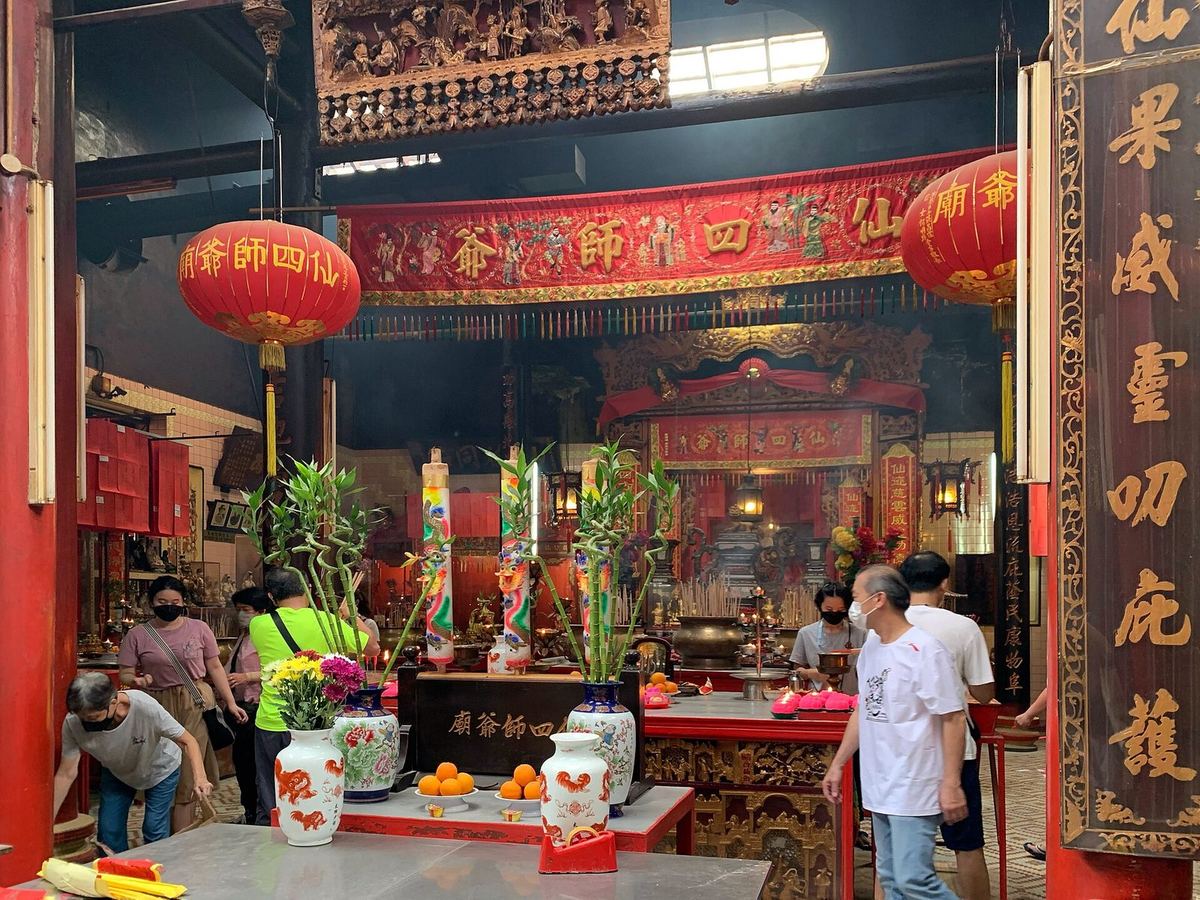
Sin Sze Si Ya Temple is the oldest Taoist temple in Kuala Lumpur, founded in 1864 by Yap Ah Loy, the Kapitan Cina (headman of the Chinese community) who did more than anyone to build the early mining town into a city. Tucked behind the shophouses between Jalan Tun H S Lee and Lebuh Pudu in Chinatown, it is small, smoky and full of character, with red and gold altars, carved panels and a steady stream of worshippers. It honours two deities whom Yap believed guided him through the Selangor Civil War, and his own memorial is inside. Entry is free, and it is a five-minute walk from Pasar Seni station.
This guide covers the temple's history, the deities and rituals, what to look for, opening hours (checked October 2026), how to find the entrance and etiquette for visitors.
| Address | 113A Jalan Tun H S Lee, Chinatown |
|---|---|
| Details | Daily 7 am – 5 pm Free |
| Area | Chinatown |
| Typical visit | About 20 min |
| Listed in | Kuala Lumpur Attractions |
| Take me here | |
| Verified | Verified October 2026 |
History of Sin Sze Si Ya Temple
The temple's story begins outside Kuala Lumpur. Sheng Meng Li (1822 to 1860), from Huizhou in Guangdong, was the Kapitan of the Chinese mining community at Sungai Ujong (around today's Seremban), respected for combining classical learning with martial skill. He was killed in fighting in 1860, aged 39. According to legend, white blood flowed from his neck when he was beheaded, which his followers took as a sign of his divinity, and he came to be worshipped as Sin Sze Ya.
Yap Ah Loy (1837 to 1885), from Guangdong, had arrived in Malaya in 1854 aged 17 and worked as a miner and trader. In 1864 he brought Sheng's spirit tablet from Rasah to Kuala Lumpur and housed it in a simple wooden shrine. Yap became the third Kapitan Cina of Kuala Lumpur in 1868 and led the Chinese miners through the Selangor Civil War (1867 to 1873), siding with Tunku Kudin; he was driven out of the town in 1872 and returned when Tunku Kudin's forces recaptured it in March 1873. He credited his survival and victories to Sin Sze Ya and to Si Sze Ya, the deified form of Chung Piang Lai, one of his own loyal generals, known as the "Ever-Victorious General".
In 1873 Yap gave land behind his house for a permanent temple, which was built in 1875. After the great fire and flood of 1881, which destroyed much of the wooden town and led Yap to rebuild Kuala Lumpur in brick and tile, the temple was reconstructed between 1881 and 1883. It was repaired again in 1938 and restored and re-consecrated in 1949 after the Second World War. In 2020 it was declared a National Heritage Site.
Yap Ah Loy died on 15 April 1885 and is buried at Kwong Tong Cemetery. His own shrine now shares the temple with the deities he honoured, and a plaque at the entrance remembers other founders of the city, including Yap Ah Shak, Chan Sow Lin and Yap Kwan Seng.
What to See at Sin Sze Si Ya Temple
The feng shui angle
Because the site behind the shophouses was chosen and aligned according to feng shui, the temple sits at an angle to the surrounding streets. You notice it in the slightly skewed walls, arches and stairways as you walk in from the alley.
The main hall
The main prayer hall holds the altar of Sin Sze Ya and Si Sze Ya, darkened by more than a century of incense smoke, with carved and gilded woodwork, lanterns and offerings. Two smaller side halls with open-air pavilions flank it. Yap Ah Loy's own shrine is among the other altars, and there is also an altar to Wenchang Dijun, the god of literature and scholarship, popular with students before exams.
Rituals to watch
Devotees believe that crawling or walking under the main altar table (traditionally three times) casts off the bad luck of the previous year, and around Chinese New Year you may see queues of people doing so. Fortune-telling with kau cim (fortune sticks) is available for about RM1, with a caretaker on hand to read the results. The temple is busiest at Chinese New Year and before major school examinations.
Opening Hours and Admission
- Hours: daily 7 am to 5 pm.
- Admission: free; donations are welcome.
- Time needed: about 20 minutes, or longer if you want to watch the rituals.
How to Get to Sin Sze Si Ya Temple
- Finding the entrance: the temple is set back from the street. Look for the ornate archway and passage off Jalan Tun H S Lee, between Jalan Tun Tan Cheng Lock and Lebuh Pudu (postal addresses are 113A Jalan Tun H S Lee and 14A Lebuh Pudu).
- LRT/MRT: Pasar Seni station is about five minutes' walk; Masjid Jamek station is a little further north.
- On foot: Central Market, Sri Mahamariamman Temple, the Guan Di Temple, Kwai Chai Hong and Petaling Street are all within five minutes.
- Grab or taxi: ask to be dropped on Jalan Tun H S Lee near Lebuh Pudu; Chinatown parking is limited.
Tips for Visiting
- This is a working temple, not a museum. Keep your voice down, do not stand in front of people praying and ask before photographing worshippers.
- Mornings are quieter and the light through the smoke is at its best; the temple closes at 5 pm.
- Dress respectfully; there is no strict dress code, but covered shoulders are appreciated.
- Combine it with the Guan Di Temple (1888) on the same street and Sri Mahamariamman Temple a short walk south for a temple walk through old Kuala Lumpur.
- Kwai Chai Hong's restored lane and murals, the hawker stalls of Petaling Street and the coffee shops along Jalan Sultan are all nearby for a break.
Sin Sze Si Ya Temple Location
Nearby
- Koong Woh Tong (Petaling Street) — Drinks, 0.1 km away
- Soong Kee Beef Noodles — Hawker food, 0.1 km away
- MaxMoney Lebuh Pudu — Money changer, 0.1 km away
- Petaling Street Air Mata Kucing — Drinks, 0.1 km away
- Kim Lian Kee Hokkien Mee — Hawker food, 0.2 km away
- Kasturi Walk — Souvenirs, 0.2 km away
Plan a route with opening times using the Where2Go trip planner.
Frequently Asked Questions
Who built Sin Sze Si Ya Temple?
It was founded in 1864 by Yap Ah Loy, the Kapitan Cina of Kuala Lumpur, for the deities Sin Sze Ya and Si Sze Ya, whom he believed guided him during the Selangor Civil War.
Is Sin Sze Si Ya Temple free to enter?
Yes. Entry is free and donations are welcome. It opens daily from 7 am to 5 pm.
How do I find the entrance to Sin Sze Si Ya Temple?
Look for the ornate archway and alley off Jalan Tun H S Lee, between Jalan Tun Tan Cheng Lock and Lebuh Pudu. The temple sits behind the shophouses, about five minutes from Pasar Seni station.
Why is the temple at an angle?
The site and alignment were chosen according to feng shui, so the temple sits at an angle to the surrounding streets, which you can see in its skewed walls and stairways.
Why do people crawl under the altar?
Devotees believe passing under the main altar table, traditionally three times, sheds the bad luck of the previous year. It is especially popular around Chinese New Year.