
Batu Caves Guide: Temple Cave, Rainbow Steps and Thaipusam
Published
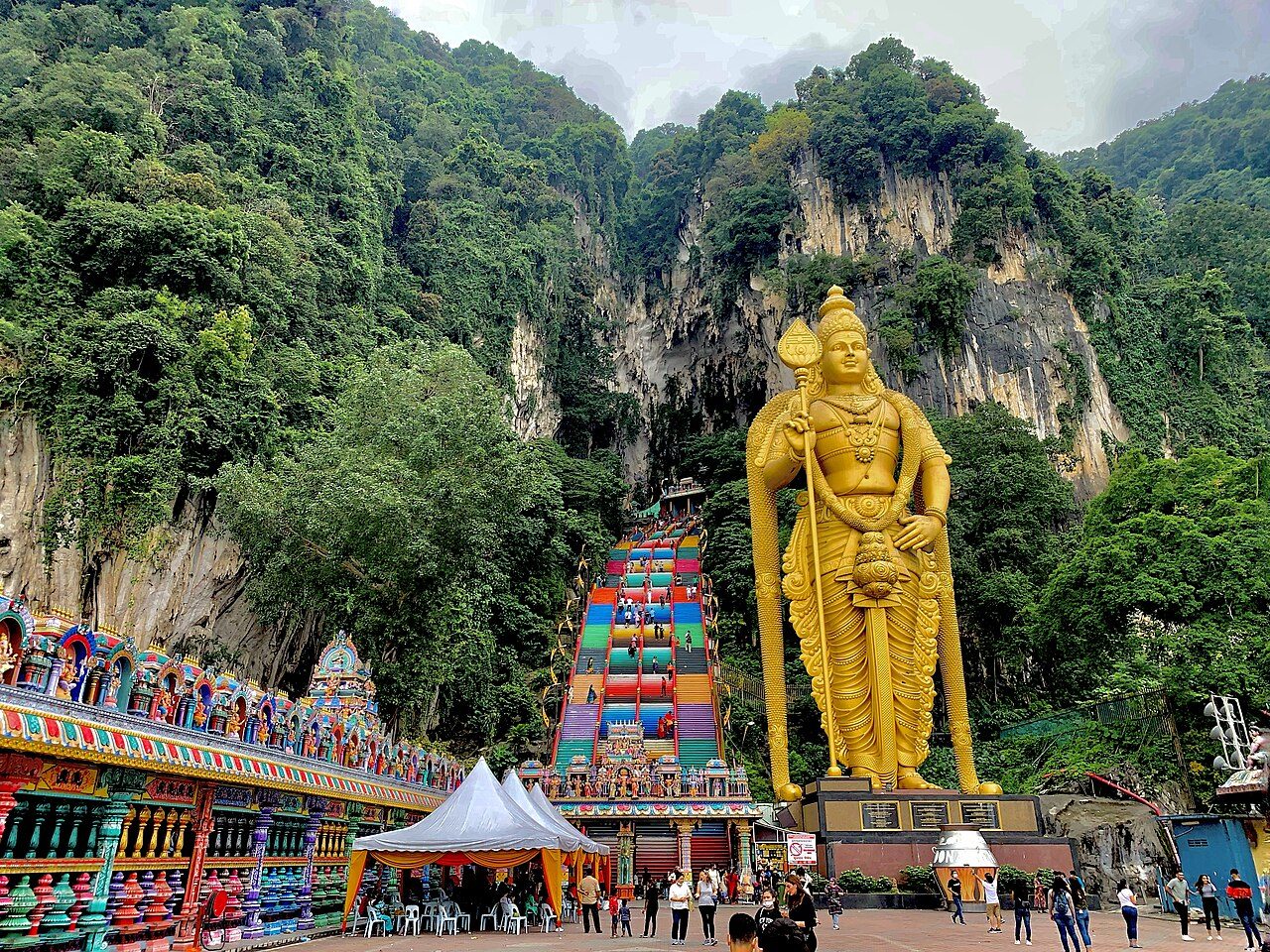
This Batu Caves guide covers what you need for a visit to Malaysia's best-known Hindu shrine: why it is famous, what you will find in each cave, what to do and what to buy, and how to get there from Kuala Lumpur. Batu Caves is a limestone hill in Gombak, Selangor, about 13 km north of the city centre. A Hindu temple to Lord Murugan sits inside its largest cavern, reached by 272 painted steps beside a 42.7-metre golden statue of the god.
The basic facts (hours, fees, history) are also on our Batu Caves page. This guide goes further, walking you through the complex in the order most people see it and adding the practical detail that helps on the day. Facts were checked in November 2026; prices are in Malaysian Ringgit (RM).
| Address | Batu Caves, 68100 Gombak, Selangor (13 km north of KL city centre) |
|---|---|
| Hours | Daily from early morning (6 am on our listing; some guides say 7 am) to about 9 pm. Ramayana Cave about 9 am – 6 pm. |
| Tickets | Temple Cave free (donation boxes). Ramayana Cave RM5. Cave Villa RM15 non-Malaysians, RM7 Malaysians. Dark Cave closed. |
| Time needed | About 1 hour for the steps and Temple Cave; 2 hours with Ramayana Cave and Cave Villa |
| Dress code | Cover shoulders and knees; sarongs can be rented at the foot of the stairs |
| Getting there | KTM Komuter to Batu Caves station, the last stop, next to the temple gate |
| Next Thaipusam | Friday 22 January 2027 |
| Verified | Verified November 2026 |
Jump to section (7)
Why Batu Caves is famous
Batu Caves is famous first as a place of pilgrimage. The temple in the main cave is dedicated to Murugan, the Hindu god of war and victory who is especially revered by Tamils, and it is the focal point of the festival of Thaipusam in Malaysia. Each year the festival brings huge crowds: ahead of Thaipusam 2026, the temple's trustees told The Star they expected more than 2.5 million people over the festival period.
It is famous, second, for two images that appear on countless postcards and phone screens. The golden statue of Lord Murugan at the foot of the hill stands 42.7 metres (140 feet) tall and is the tallest statue in Malaysia. Beside it, the 272 steps up to the Temple Cave were painted in bands of bright colour in 2018, which turned an ordinary concrete staircase into one of the most photographed scenes in the country.
Third, it is a natural site as well as a religious one. The hill is a limestone outcrop riddled with around 20 recognised caves, with stalactites, stalagmites and flowstone, and it supports a long list of plants and animals. Wikipedia, citing scientific surveys, counts about 269 vascular plant species, 21 species of bats and the trapdoor spider Liphistius batuensis, which is found nowhere else. Long-tailed macaques are everywhere on the steps.
Finally, it is easy to reach. A commuter train runs from KL Sentral straight to a station beside the temple gate, the main cave costs nothing to enter, and most visitors are in and out in a morning. That combination makes it one of the most visited sights around Kuala Lumpur.
History of Batu Caves in brief
The limestone itself is very old, often given as more than 400 million years, although the caves formed much later as water slowly dissolved the rock. Long before the temple, the indigenous Temuan people used the caves as shelters. From the 1860s Chinese settlers dug bat guano from the cave floors to sell as fertiliser, and the American naturalist William Hornaday visited and described the caves in 1878.
The Hindu shrine is owed to K. Thamboosamy Pillay, a Tamil community leader in Kuala Lumpur who also founded the Sri Mahamariamman Temple in Chinatown. The entrance of the main cave is said to resemble the vel, the spear carried by Murugan, and this inspired him to dedicate a temple there. The temple was completed in 1891 and the first Thaipusam was celebrated at the caves in 1892. Pilgrims climbed wooden steps installed in 1920, which were replaced in 1940 by the 272 concrete steps still used today.
The golden Murugan statue was begun in 2004 and unveiled on 29 January 2006, during Thaipusam. Built by artisans from India and paid for by the Tamil community, it took about three years and used 1,550 cubic metres of concrete, 350 tonnes of steel and 300 litres of gold paint, at a reported cost of about RM2.5 million. Ahead of Thaipusam 2026 it was refurbished with extra lighting.
In August 2018 the temple repainted the steps in rainbow colours. The site is on the National Heritage Register, and the National Heritage Department said the work had not been approved under the National Heritage Act 2005; the temple committee chairman, R. Nadarajah, replied that the steps are repainted regularly to keep the place clean and attractive. The colours stayed, and they are now the site's signature look. The temple is run by the same trust as the Sri Mahamariamman Temple in Chinatown. A long-discussed escalator up the hill was the subject of a dispute with the Selangor state government in January 2026; the two sides agreed it could go ahead once all technical and regulatory conditions are met, and no completion date had been announced when we checked.
What's inside Batu Caves: a walk through the complex
Coming from the train station, you walk into a wide paved plaza at the foot of the cliff. The main staircase and the Murugan statue are straight ahead, the Ramayana Cave and the Hanuman statue are to the left, and Cave Villa is near the station side. Most people climb first, while it is cooler, and visit the ground-level caves afterwards.
The plaza and the Murugan statue
The plaza is lined with small shrines, stalls and vegetarian restaurants. Look out for the statue of a five-legged bull in the courtyard, which commemorates a bull that lived in the temple grounds until it died of old age. The best photos of the golden statue with the coloured steps behind it are taken from the open plaza, ideally in the soft light of early morning.
The 272 steps
The staircase is steep but short: most people reach the top in 10 to 15 minutes, with places to stop and catch their breath. Macaques sit on the railings and steps and will grab food, drinks and plastic bags, so keep snacks out of sight. Halfway up, a side path leads to the entrance of the Dark Cave (see below).
Temple Cave (free)
At the top, the Temple Cave, also called the Cathedral Cave, is an enormous chamber with a high vaulted ceiling, water dripping from the rock and shrines to Murugan and other deities. At the far end, a few more steps lead into a second chamber whose roof is open to the sky, so daylight falls into the cave. A temple here, dedicated to Murugan's consorts Valli and Deivanai, marks the site of the first shrine. Priests perform prayers throughout the day; you are welcome to watch quietly. Entry is free and there are donation boxes.
Ramayana Cave and the Hanuman statue (RM5)
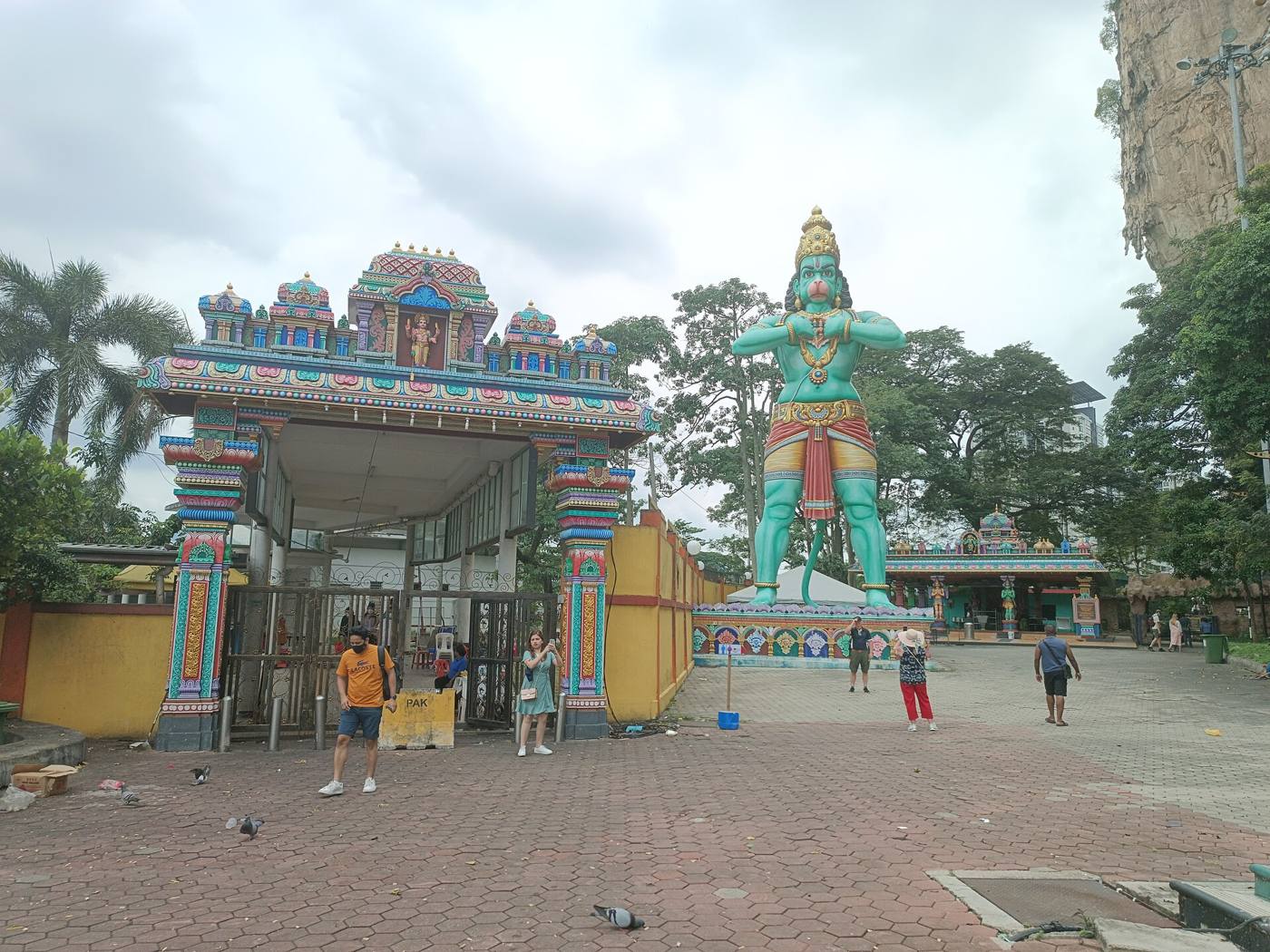
To the left of the main stairs stands a 15-metre green statue of Hanuman, the monkey god, next to a Hanuman temple that opened in November 2001. Behind them is the Ramayana Cave, which tells the story of the Hindu epic the Ramayana in brightly painted statues and scenes along a winding route. It costs RM5 and takes about 20 to 30 minutes. Several travel writers rate it the most rewarding of the paid caves.
Cave Villa (RM15 non-Malaysians, RM7 Malaysians)
Cave Villa occupies the two caves at the base of the hill that Wikipedia calls the Art Gallery Cave and the Museum Cave. You cross a crooked bridge over a carp pond to reach them. Inside, coloured lights pick out statues and paintings of Hindu gods, scenes from Murugan's life and figures of Indian poets. There are also tanks of reptiles and some caged animals; at least one 2026 travel guide raises animal-welfare concerns, so you may prefer to skip it. It is a commercial attraction rather than a place of worship.
Dark Cave (closed)
The Dark Cave is an undeveloped cave system off the main staircase, protected for its wildlife, including the rare trapdoor spider. Guided tours were run by a group linked to the Malaysian Nature Society until January 2019, when they stopped. As of our check in November 2026, guides updated in 2026 still report it closed with no reopening date, so don't plan your visit around it. If tours restart, expect them to be guided only and booked in advance.
What to do at Batu Caves
Climb early and watch the morning prayers
Arriving soon after opening gives you cooler air, the best light on the statue and a quieter Temple Cave, before tour groups start arriving at around 10 am. If you are lucky, you will see a blessing or family ceremony at one of the shrines at the foot of the hill. Watch from a respectful distance and ask before photographing people.
See Thaipusam (22 January 2027)
Thaipusam falls in the Tamil month of Thai, in January or February. In 2027 it is on Friday 22 January, a public holiday in Kuala Lumpur, Selangor and several other states. The night before, a silver chariot of about 350 kg carrying Murugan with Valli and Deivanai leaves the Sri Mahamariamman Temple on Jalan Tun H.S. Lee in Chinatown and is pulled through the streets overnight; in 2026 it set off at about 9 pm and reached Batu Caves the next morning, with road junctions closed in stages along the way.
At the caves, devotees bathe in the river, then climb to the Temple Cave to fulfil vows. Many carry pots of milk (paal kudam) on their heads; others bear a kavadi, a decorated frame carried on the shoulders, and some have hooks and skewers through the skin. Devotees typically prepare with weeks of fasting, a vegetarian diet and prayer. It is an extraordinary sight, but very crowded. Go before dawn, wear shoes you can carry in a bag (the temple asks visitors not to abandon footwear; nearly three tonnes of shoes were left behind in 2025) and expect to queue for trains.
Rock climbing and caving
The north-eastern side of the hill, around the Damai caves, is one of the best-known climbing areas near KL, with nearly 160 routes on cliffs up to about 150 metres high. Local companies run guided climbing, abseiling and caving trips for beginners; ask about the condition of the bolts, as the humid climate corrodes them faster than in drier places.
Photo spots
The classic shot is the statue and steps from the middle of the plaza. Halfway up, turn round for the view over the plaza and the station. Inside the Temple Cave, the light falling through the open roof of the inner chamber is best from mid-morning. The Hanuman statue and the painted gateways of the smaller temples at ground level are good subjects too.
Combine it with nearby sights
Batu Caves sits on the northern edge of the city, so it pairs well with other sights on that side. The Royal Selangor Visitor Centre in Setapak Jaya offers a free guided tour of its pewter factory. In the city, end the day at Sri Mahamariamman Temple in Chinatown, where the Thaipusam chariot starts, or at Little India in Brickfields for Indian shops and food.
What to buy and eat at Batu Caves
Stalls in the plaza
Shops and stalls around the plaza sell religious items such as incense and small statues of Hindu gods, along with traditional Indian clothing, handicrafts and souvenirs. Prices are not displayed everywhere, so ask before you buy. Some tour guides take groups to handicraft shops on the way, where they may earn a commission; you are under no obligation to buy.
Food at the foot of the hill
A row of vegetarian South Indian restaurants faces the plaza. Restoran Rani, near the stairs to the Temple Cave, serves vegetarian thali sets, banana-leaf meals and thosai (dosa), and Rani Vilas serves banana-leaf rice with dal and condiments; a reviewer in 2023 noted a minimum spend for card payments. Rajan is another of the cluster of vegetarian restaurants in the temple grounds. Malaysia Traveller has quoted about RM9 for a vegetarian banana-leaf meal with coconut water, but that price is a few years old, so check the menu. Expect thosai, idli, vadai and Indian sweets such as gulab jamun.
After the climb, buy a fresh coconut from the stalls near the bottom of the stairs; the water is the most popular cold drink in the plaza. Bring cash in small notes for the stalls and donation boxes (see our guide to payment methods in Malaysia).
Better shopping elsewhere
For more choice of Indian textiles, spices, sweets and flower garlands, Little India in Brickfields and the Jalan Masjid India area in the city centre have far more shops than the caves. For a Malaysian-made souvenir, Royal Selangor pewter (above) is nearby, and our Kuala Lumpur souvenirs guide lists other options.
Practical guide to visiting Batu Caves
Getting there
- KTM Komuter: trains from KL Sentral (also stopping at Kuala Lumpur, Bank Negara and Putra) run to Batu Caves station, the end of the line, a few steps from the temple. The fare from KL Sentral has been reported as RM2.60 in cash or RM2.30 with Touch 'n Go. Because of double-tracking works, KTMB cut the frequency on the Batu Caves line from 18 April 2026 until the end of December 2026, with trains every 15 to 30 minutes at peak times and longer gaps in between, so check the KTMB timetable before you go. Trains have ladies-only coaches.
- Bus: Wikipedia lists bus 11 from the Bangkok Bank stop near Central Market; the train is usually simpler.
- Grab or taxi: the easiest choice for groups or if you are combining the caves with Royal Selangor. The journey depends heavily on traffic; check the fare in the app.
- Car: there is parking beside the complex, but the road layout around it is confusing and car parks fill up at weekends and close to cars during Thaipusam.
- During Thaipusam: in 2026 KTM ran trains round the clock for four days, made Komuter rides free on the two main days and added free shuttle buses from Pasar Seni, LRT Gombak and MRT Kampung Batu. Watch for the 2027 arrangements in January.
Best time to go
Early morning on a weekday is best: cooler, quieter and with good light. Late afternoon is the next best option. Avoid midday, when the steps are hot and crowds peak. Unless you want to see the festival, avoid the days around Thaipusam, when the site is extremely crowded and roads are closed.
Dress code and etiquette
This is a working Hindu temple. Men and women should cover their shoulders and knees; short shorts, short skirts and sleeveless tops are not allowed in the caves. Sarongs can be rented at the foot of the stairs for a small deposit, part of which is refunded (reported amounts vary, so carry a few ringgit), though the service is not always available early in the morning. Take off your shoes before entering inner shrines, keep your voice down and don't touch offerings.
Monkeys
The macaques mostly leave people alone, but they snatch anything that looks like food. Don't feed them, carry food in a closed bag, hold on to sunglasses and phones, and don't carry plastic bags on the stairs.
Accessibility
There is currently no lift or escalator to the Temple Cave, and the 272 steps are steep and can be slippery after rain. Visitors with limited mobility can still enjoy the plaza, the Murugan statue, the Hanuman statue and the Ramayana Cave at ground level.
What to bring
Water, a hat or umbrella, shoes with grip, a light scarf or sarong, small notes in cash and a bag for your shoes if you visit during a festival.
Batu Caves FAQ
Is Batu Caves free to enter?
Yes. The Temple Cave at the top of the 272 steps is free, with donation boxes inside. The Ramayana Cave costs RM5, and Cave Villa costs RM15 for non-Malaysians and RM7 for Malaysians. The Dark Cave is closed.
How long do you need at Batu Caves?
About an hour for the steps and the Temple Cave, and about two hours if you add the Ramayana Cave, Cave Villa and a meal in the plaza. Allow extra time for the train or the drive from central Kuala Lumpur.
Is the Dark Cave at Batu Caves open?
No. Guided tours stopped in January 2019, and guides updated in 2026 still report the Dark Cave closed with no reopening date. Check with the Malaysian Nature Society before planning a visit around it.
When is Thaipusam at Batu Caves in 2027?
Thaipusam falls on Friday 22 January 2027, a public holiday in Kuala Lumpur and Selangor. The silver chariot procession from the Sri Mahamariamman Temple in Chinatown usually leaves the evening before and reaches Batu Caves the next morning.
Is there an escalator at Batu Caves?
Not yet. An escalator has been planned since 2024, and in January 2026 the Selangor government and the temple agreed it can go ahead once all technical and regulatory conditions are met. No completion date had been announced when we checked in November 2026.
What should I wear to Batu Caves?
Cover your shoulders and knees: no short shorts, short skirts or sleeveless tops. Sarongs can be rented at the foot of the stairs for a small deposit. Wear shoes with good grip for the steep steps.
Sources
- Wikipedia: Batu Caves
- Wikipedia: Batu Caves Murugan Statue
- Time Travel Turtle (updated Sep 2026): Guide to visiting Batu Caves
- Malaysia Traveller: Batu Caves
- The Star (Jan 2026): Thaipusam at Batu Caves to draw over 2.5 million visitors
- The Star (Jan 2026): Round-the-clock train service for Thaipusam
- Varnam Malaysia (Jan 2026): Selangor and Batu Caves temple reach understanding on escalator
- Varnam Malaysia (Apr 2026): KTMB restructures Klang Valley Komuter schedule
- EdgeProp (2018): Batu Caves temple committee on heritage status
- PublicHolidays.com.my: Thaipusam 2027