
Kek Lok Si Temple Guide: Penang's Temple of Supreme Bliss
Published
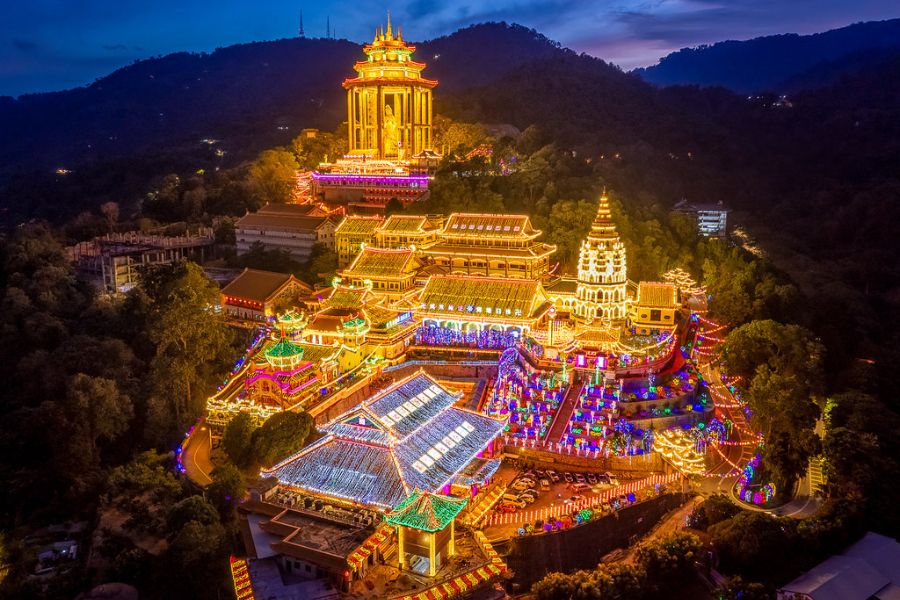
This Kek Lok Si Temple guide covers everything you need for a visit to the largest Buddhist temple in Malaysia: why it is famous, what you will see on each tier of the hillside, what to do and what to buy, and how to get there. Kek Lok Si climbs Crane Hill above Air Itam, about 20 minutes by car from George Town. Its name means "Temple of Supreme Bliss", and it is both an active monastery and one of Penang's most visited sights.
The basic facts (hours, fees, history) are also on our Kek Lok Si Temple page. This guide goes further, walking you through the complex in the order you will see it and adding the practical detail that helps on the day. Facts were checked in October 2026; prices are in Malaysian Ringgit (RM).
| Address | Kek Lok Si Temple, Air Itam, 11500 Penang |
|---|---|
| Hours | Daily 8:30 am – 5:30 pm, including public holidays; open into the evening during the Chinese New Year light-up |
| Tickets | Free main grounds. Pagoda RM2. Inclined lift to the Kuan Yin statue charged per ride; published fares differ (see below), so carry small notes. |
| Payment | Cash for pagoda and lift tickets |
| Time needed | 2 to 3 hours for the halls, pagoda and Kuan Yin statue |
| Dress code | No enforced dress code, but cover shoulders and knees; shoes off in prayer halls |
| Getting there | Rapid Penang bus 201 or 203 to Air Itam, then about 10 minutes' walk uphill; Grab about 15–25 minutes from George Town; paid car parks on site |
| Verified | Verified October 2026 |
Jump to section (7)
Why Kek Lok Si Temple is famous
Kek Lok Si is famous first for its size. It is the largest Buddhist temple in Malaysia, a complex of prayer halls, shrines, courtyards, gardens and car parks stacked up a hillside on several tiers. Its white pagoda and the tall pavilion of the Kuan Yin statue stand high above the roofs of Air Itam.
It is famous, second, for two landmarks. The seven-storey Ban Po Thar, the Pagoda of Ten Thousand Buddhas, mixes three styles in one tower: a Chinese octagonal base, a Thai middle section and a Burmese spiral crown. Above it, the bronze statue of Kuan Yin, the Goddess of Mercy, stands 30.2 metres tall under a roofed pavilion. Together they are the image most people have of the temple.
Third, it is a living religious centre. Kek Lok Si was founded as a monastery, monks still live and pray here, and it draws pilgrims from Singapore, Hong Kong, the Philippines and elsewhere in Southeast Asia as well as Penang's own Buddhist community. On Wesak Day and at Chinese New Year the hillside fills with devotees.
Finally, it is known for its Chinese New Year light-up. For a few weeks each year the whole complex is strung with lanterns and coloured lights. In 2026 the lights were switched on from 13 February until Chap Goh Mei, the 15th day of the lunar new year, with more than 10,000 traditional lanterns plus thousands of LED and neon lights, according to reports in the New Straits Times and Bernama.
History of Kek Lok Si in brief
The temple was started by Beow Lean, a Buddhist monk from Fujian in China who served as chief monk of the Kuan Yin Teng (Goddess of Mercy Temple) on Pitt Street in George Town. Wanting a proper monastery in the hills, he chose Crane Hill in Air Itam, a site picked partly for its feng shui. Building began around 1890–1891, funded largely by wealthy Chinese merchants of Penang and Malaya, and the first phase was finished around 1904–1905.
In 1904 Beow Lean travelled to Beijing and was received by the Guangxu Emperor, who gave the temple a large set of Buddhist scriptures and named him Chief Priest of Penang, recognising Kek Lok Si as the head of the Chinese temples in the region.
The pagoda came next. Work began in 1915 under the second abbot, Ben Zhong, and King Vajiravudh (Rama VI) of Siam laid the foundation stone, which is why it is sometimes called the Rama VI Pagoda. It was completed in 1930 and opened with ceremonies held every seven days over 49 days.
The temple has kept building. An older white Kuan Yin statue on the upper slope was damaged by fire, and its 30.2-metre bronze replacement was completed at the end of 2002. The pavilion over it, an octagonal roof on 16 pillars, was consecrated on 6 December 2009. In 2021 the temple opened the Kek Lok Si Charitable Hospital down the road. On 12 October 2021 an early-morning fire, thought to have been started by a rodent knocking over an oil lamp, destroyed one prayer room; the trustees said it affected about 1% of the buildings, and no one was hurt. For a longer history, see our Kek Lok Si Temple page.
What's inside Kek Lok Si: a walk through the tiers
The complex is easiest to understand as three main levels. If you arrive by bus or on foot from Air Itam market, you start at the bottom and climb. If you come by Grab or car, you can be dropped at a higher car park and skip some of the stairs.
The covered walkway
From the foot of the hill near Air Itam market, a covered, stepped passage lined with stalls leads up to the temple. It takes about 10 minutes and is steep in places. The stalls sell souvenirs, T-shirts, incense, prayer items and snacks (more in What to buy).
Lower tier: Liberation Pond and Hall of the Heavenly Kings
The walkway brings you to the Liberation Pond, also called the Tortoise Pond, which holds hundreds of tortoises and turtles, some of them decades old. Devotees release them here as an act of merit, part of the Buddhist practice of compassion towards living beings.
Beyond it is the Hall of the Heavenly Kings, guarded by four large statues of the Heavenly Kings, each watching over one of the four points of the compass. This is the classic entrance hall of a Chinese Buddhist monastery.
Middle tier: prayer halls, courtyards and the pagoda
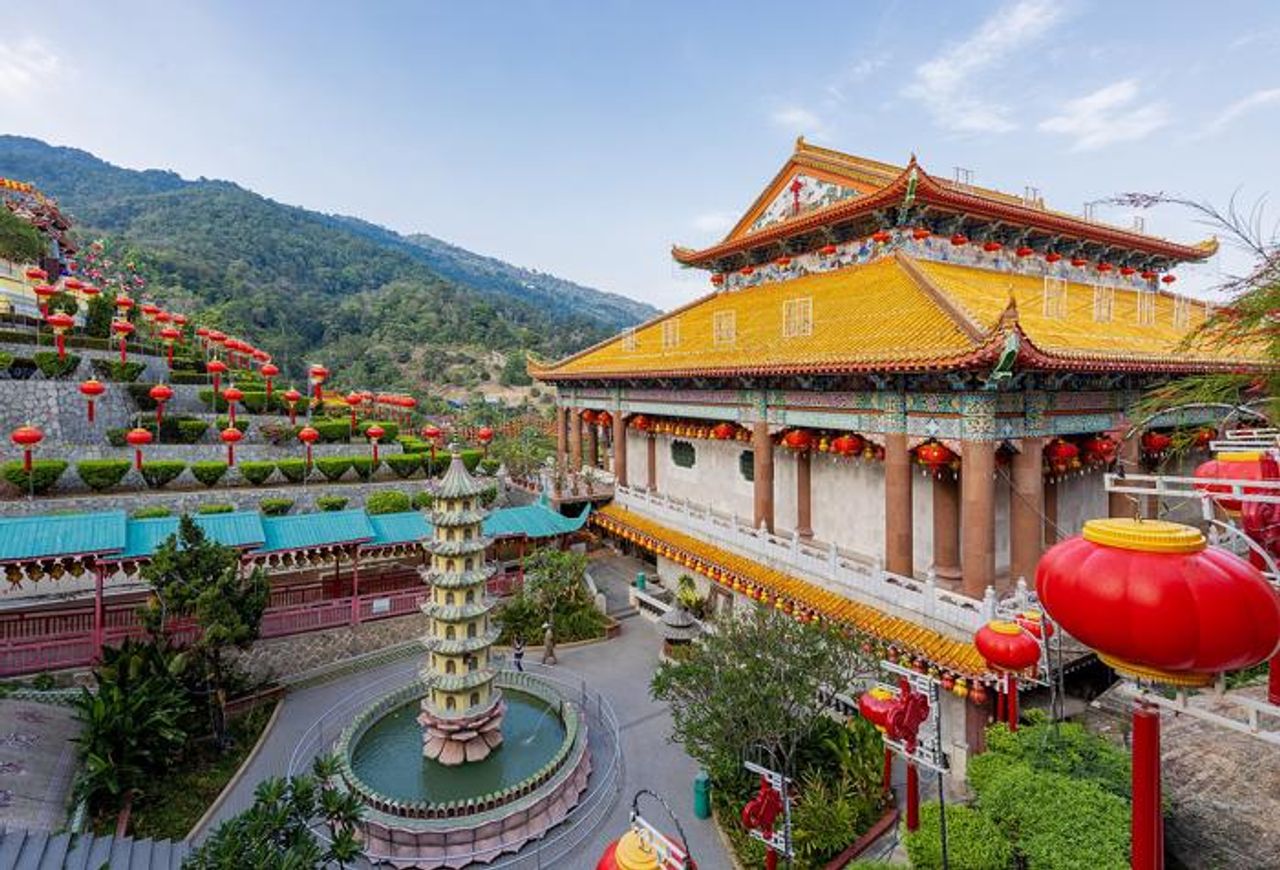
The middle tier is the heart of the monastery. The Hall of Bodhisattvas holds golden statues set in carved wooden screens, and the main prayer hall is dedicated to the Buddha. Between the halls are courtyards with ponds, potted plants, smaller pagodas and rows of red lanterns. A temple shop here sells religious items, with proceeds going to the temple building fund.
The Ban Po Thar pagoda rises from this level. It is about 30 metres tall and has seven storeys. Climbing it costs RM2. The stairs inside are narrow, and each level holds Buddha images; the name comes from the roughly 10,000 Buddha images in alabaster and bronze inside. From the upper balconies you look out over Air Itam and towards George Town and the sea.
Upper tier: the Kuan Yin statue
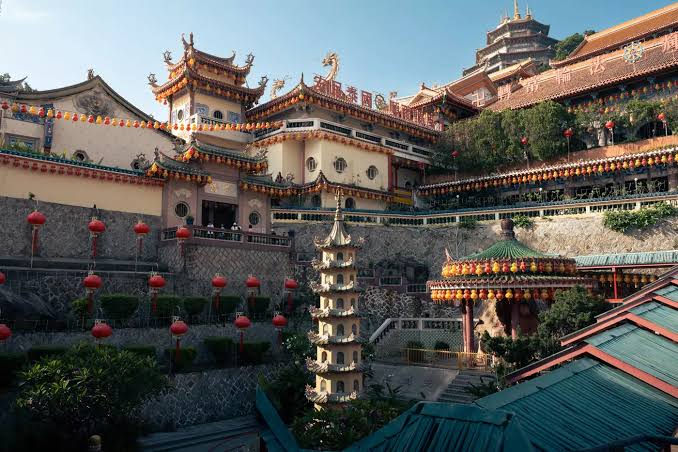
An inclined lift (a short cable-hauled car on rails) carries visitors from the middle area up to the Kuan Yin terrace. You can also drive or take a Grab to the upper car park. At the top, the 30.2-metre bronze Kuan Yin stands under her tall pavilion on 16 pillars, surrounded by rows of smaller Kuan Yin statues. On the same level are statues of the 12 animals of the Chinese zodiac, a favourite with visitors who look for their birth year. The terrace gives the best overall view of the temple roofs and pagoda below.
What to do at Kek Lok Si
- Climb the pagoda (RM2). The views from the top balconies are one of the highlights of a visit. Allow 20–30 minutes and take care on the narrow steps.
- Ride the inclined lift to Kuan Yin. Many visitors take the lift up and walk back down through the gardens, which saves energy for the steepest part.
- Find your zodiac animal. The 12 zodiac statues on the upper level are a popular photo stop.
- Watch the temple at worship. Kek Lok Si is a place of prayer, and you will see devotees offering incense and praying in the halls, and turtles released at the Liberation Pond as an act of merit. Follow the lead of local worshippers and stay out of the way of ceremonies in progress.
- Visit during the Chinese New Year light-up. The temple stays open into the evening and the hillside is lit with thousands of lanterns. Arrive before dusk to see the lights come on, and expect heavy crowds.
- Visit on Wesak Day. On the Buddha's birthday the temple fills with devotees from early morning; Bernama reported crowds from about 8 am. It is a good day to see the temple as a place of worship, but not if you want quiet.
- Photo spots. Popular shots are the pagoda framed by the courtyard lanterns on the middle tier and the Kuan Yin pavilion from the upper terrace.
- Combine it with nearby sights. The Penang Hill funicular lower station is about 3 km away, roughly 10 minutes by car, so many visitors do both in one day: Kek Lok Si in the morning, lunch in Air Itam, Penang Hill in the late afternoon for the sunset and city lights.
What to buy and eat at Kek Lok Si
Souvenirs on the walkway
The covered walkway up from Air Itam is lined with stalls selling inexpensive souvenirs: trinkets, T-shirts, pocket-sized models of the temple, incense, prayer items and religious figures (Buddhist, Taoist and even Catholic). Reviewers describe much of it as touristy, so treat it as fun shopping rather than fine craft. Some stalls also sell Penang snacks.
The temple shop
On the middle tier the temple's own shop sells religious items, talismans and souvenirs. Money spent here goes to the temple's building fund, so it is the better choice if you want your purchase to support Kek Lok Si.
Food nearby
Air Itam market at the foot of the hill is one of Penang's food landmarks. The Air Itam laksa stall beside the market is the most famous: sour, fish-based asam laksa for about RM6–7 a bowl. It trades mainly at weekends from about 11 am until sold out, and weekday trading varies, so check before you plan around it. Expect a queue. If you want Penang specialities to take home, see our guides to Penang local products and Penang souvenirs.
Practical guide to visiting Kek Lok Si Temple
Opening hours and tickets
- Hours: daily 8:30 am to 5:30 pm, including public holidays. During the Chinese New Year light-up the temple stays open into the evening.
- Entry: the temple grounds are free.
- Pagoda: RM2 per person.
- Inclined lift: charged per ride. Published fares disagree: Penang Travel Tips lists RM16 for a return trip, while several 2025–2026 visitor guides quote RM2–3 per ride. Check the board at the lift station and carry small notes.
- Payment: cash for the pagoda and lift.
Getting there
- Bus: Rapid Penang buses 201 and 203 run to Air Itam (201 from KOMTAR, about 30 minutes; 203 from Weld Quay). Get off near Air Itam market on Jalan Balik Pulau and walk up the covered walkway, about 10 minutes. Bus 204 also passes through Air Itam on its way to the Penang Hill lower station. Pay cash with exact change, or check fares and times in the Prasarana PULSE app.
- Grab or taxi: about 15–25 minutes from George Town, depending on traffic. Ask to be dropped at the upper car park near the Kuan Yin pavilion if you want to avoid the climb.
- Car: there are several paid car parks at different levels: a lower car park near the Tortoise Pond, a middle one near the Hall of Bodhisattvas and an upper one near the Kuan Yin pavilion (about RM3). Parking fills up at weekends and festivals, so arrive early.
Best time to visit
Come early on a weekday morning, ideally soon after 8:30 am. Tour buses arrive from late morning, and Penang's midday heat makes the stairs hard work. Late afternoon is pleasant too, but leave enough time before the 5:30 pm closing. For the light-up, visit in the weeks around Chinese New Year (usually late January to February) and go on a weekday evening if you can.
Etiquette and dress
Staff have told visitors there is no specific dress code, but this is a working monastery, so cover your shoulders and knees. Take off your shoes where signs ask you to before entering prayer halls; slip-on shoes help. Keep your voice down and don't photograph monks or worshippers at close range without asking.
Accessibility
Kek Lok Si involves a lot of steps and slopes. The lower walkway from the market is stepped and steep. For older visitors, wheelchair users or families with prams, the easiest approach is by car or Grab to the middle or upper car park, then the inclined lift between the middle tier and the Kuan Yin terrace. Some halls and the pagoda are only reachable by stairs.
What to bring
Water, a hat or umbrella for sun and rain, comfortable shoes, and small notes for tickets, donations and the market. The nearest emergency department is at the Kek Lok Si Charitable Hospital on Jalan Balik Pulau, a few minutes away.
Kek Lok Si Temple FAQ
Is Kek Lok Si Temple free to enter?
Yes. The temple grounds are free. Climbing the Ban Po Thar pagoda costs RM2, and the inclined lift to the Kuan Yin statue is charged per ride, so bring small notes in cash.
How long do you need at Kek Lok Si?
Allow 2 to 3 hours to see the lower halls, climb the pagoda and ride up to the Kuan Yin statue. Add an hour if you plan to eat at Air Itam market or walk every terrace.
Why is Kek Lok Si famous?
It is the largest Buddhist temple in Malaysia, founded in 1890–1891, with a seven-storey pagoda that mixes Chinese, Thai and Burmese styles and a 30.2-metre bronze statue of Kuan Yin. It is also known for its Chinese New Year light-up with more than 10,000 lanterns.
When is the Kek Lok Si Chinese New Year light-up?
The lights run for a few weeks from around Chinese New Year until Chap Goh Mei, the 15th day of the lunar new year. In 2026 they were switched on from 13 February. Check local news for the next season's dates.
How do I get to Kek Lok Si by bus?
Take Rapid Penang bus 201 from KOMTAR or 203 from Weld Quay to Air Itam, get off near Air Itam market and walk up the covered walkway to the temple, about 10 minutes uphill.
What should I wear to Kek Lok Si?
There is no strictly enforced dress code, but covering shoulders and knees is respectful in a working monastery. Wear comfortable shoes that are easy to take off, as there are many steps and you remove shoes in some halls.
Sources
- Wikipedia: Kek Lok Si
- Penang Travel Tips (Timothy Tye): Kek Lok Si Temple
- Penang Travel Tips: Kuan Yin Goddess of Mercy Pavilion
- New Straits Times (Feb 2026): Kek Lok Si lights up with 10,000 lanterns
- The Vibes (Oct 2021): Kek Lok Si fire not major
- Bernama: Wesak Day at Kek Lok Si
- OnPenang: Kek Lok Si Temple (car parks)
- Travels with Sun: Kek Lok Si Temple guide
- Penang Itinerary (2026): Kek Lok Si Temple guide