
Sultan Abdul Samad Building
Last updated: October 2026
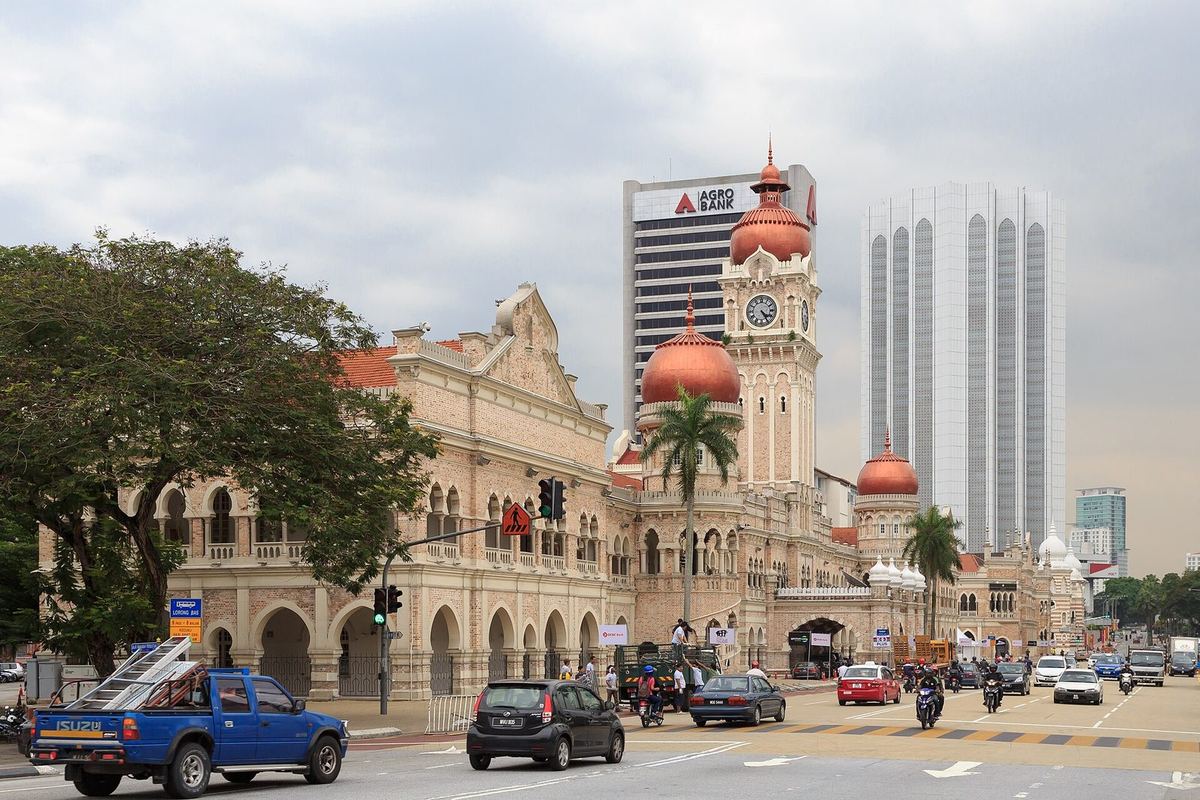
The Sultan Abdul Samad Building (Bangunan Sultan Abdul Samad) is the long red-brick building with the 41-metre clock tower and three copper onion domes on Jalan Raja, facing Merdeka Square. Completed in 1897 as the headquarters of the British colonial administration, it later housed Malaysia's highest courts, and its clock chimed as the Union Flag came down on the eve of independence in 1957. After a restoration completed in early 2026, the building is open to the public for the first time in decades, with the Kuala Lumpur City Gallery, a Royal Selangor pewter gallery, cafés and restaurants inside.
This guide covers the building's history and architecture, the 2025–26 restoration, what you can see inside now, opening hours and admission (checked October 2026), and how to get there.
| Address | Jalan Raja, Dataran Merdeka |
|---|---|
| Details | Building and grounds open daily 8 am – 10 pm (free). Kuala Lumpur City Gallery daily 9 am – 6 pm: free for Malaysians, ticketed for non-Malaysians. Royal Selangor Gallery: free. |
| Area | Dataran Merdeka |
| Typical visit | About 1 hour (1.5–2 hours with the galleries and a meal) |
| Listed in | Kuala Lumpur Attractions |
| Take me here | |
| Verified | Verified October 2026 |
History of the Sultan Abdul Samad Building
When the British moved the capital of Selangor from Klang to Kuala Lumpur in 1880, the government offices were put on Bluff Hill, today's Bukit Aman, overlooking the Padang. They soon ran out of space, and the public complained about climbing up and down the hill. The State Engineer, Charles Edwin Spooner, proposed new offices on the flat ground beside the Klang River, near the confluence where the town had begun. An expensive first scheme was rejected, but the British Resident, William Edward Maxwell, accepted a cheaper second proposal.
The first design, by the State Architect A. C. Norman and his assistant R. A. J. Bidwell, was in a Classical Renaissance style. Spooner disliked it, and Bidwell reworked it under his direction into the Indo-Saracenic (or Neo-Mughal) style seen today, mixing Mughal, Moorish and Gothic details. Arthur Benison Hubback, then a newly arrived draughtsman, also contributed and designed many fittings. Only Norman's name appears on the foundation stone, but much of the design is Bidwell's. The choice of an Islamic-inspired style was deliberate, meant to suit the Muslim ruler of Selangor while projecting British authority.
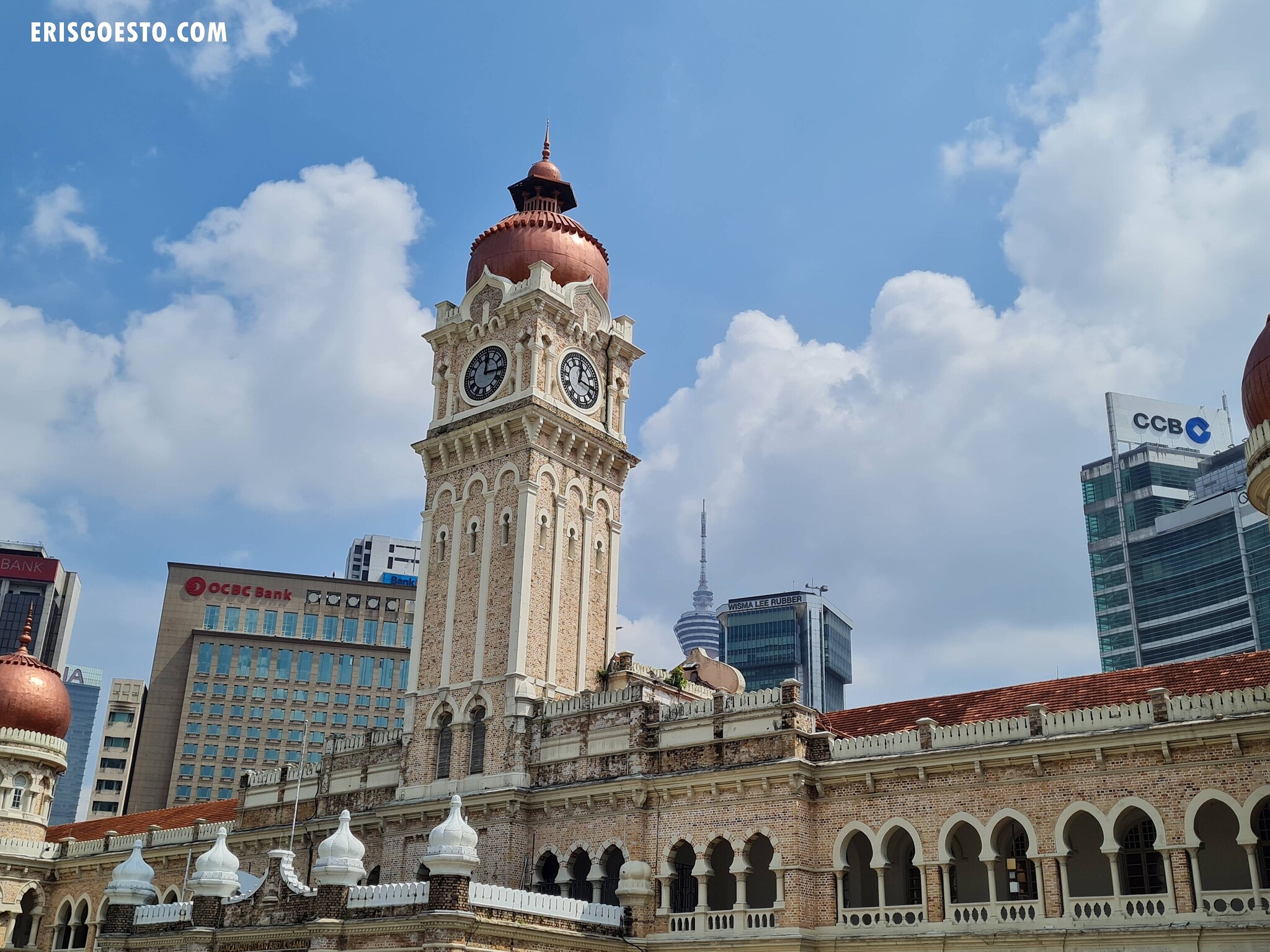
The foundation stone was laid on 6 October 1894 by Sir Charles Mitchell, Governor of the Straits Settlements. Construction used about four million bricks made at a works Spooner set up in what became Brickfields, plus copper, steel, timber, lime and cement, and cost 152,000 Straits dollars. Spooner added extra brickwork to the lower walls because the site was so close to the river. The building, then the largest in Malaya, has a facade of about 137 metres along Jalan Raja, two storeys with wide verandahs, and three towers: a 41-metre central clock tower designed to echo London's Big Ben, flanked by two smaller towers with staircases. Its red brick with white plaster bands is often called the "blood and bandages" style.
It was officially opened by Frank Swettenham in April 1897, celebrated with a ball and gas floodlighting of the facade, the first time such lighting was used in Kuala Lumpur. The clock, made by Gillett & Johnston of Croydon, first chimed in June 1897 for Queen Victoria's Diamond Jubilee. Known simply as the Government Offices, the building took in nine departments, including the Secretariat, Treasury, Audit, Land, Survey, Mines, Public Works and the Post Office, and in the same period Kuala Lumpur became capital of the new Federated Malay States (1896), so it became the administrative centre of the federation. A rear wing was added in 1903 and, in 1907, a matching General Post Office to the south, designed by Hubback.
The small spires on the clock tower were removed in 1939 as an air-raid precaution. The clock has stopped only once, after it was hit in a Japanese air raid in 1941; staff from the Department of Survey and Mapping still wind it by hand every few days. At midnight on 30 to 31 August 1957, as the clock struck twelve, the Union Flag was lowered on the Padang in front of the building and the flag of independent Malaya raised.
After independence the building housed the Selangor state government until the state offices moved to Shah Alam. In 1974, when Selangor ceded Kuala Lumpur to become a Federal Territory, the building was renamed after Sultan Abdul Samad, who ruled Selangor when it was built. It was then converted for the judiciary in a renovation that took about six years and cost RM17.2 million; the Supreme Court (later the Federal Court) and the High Court sat here until the Federal Court moved to Putrajaya in 2003 and the High Court left in 2007. Government ministries used it afterwards. It was gazetted as a National Heritage Site in 2007.
The 2025–26 Restoration
Under the Warisan KL programme, Khazanah Nasional's heritage fund, Dana Warisan, took on the building and five neighbours as the BSAS Complex. Conservation of the main building took about 11 months, with Think City as heritage adviser. The team rebuilt the three copper domes with a new waterproof layer, reconstructed the copper finial and reinstated the parapet finials and tower spires, removed cement mortar by hand and replaced it with lime plaster so that the original pink-toned bricks could breathe, cleared an electrical substation that had blocked the rear verandah for decades, and stabilised and exposed the 1890s vaulted ceilings. They also found and restored a tunnel built in the 1980s to move detainees to a courtroom.
Malaysia's King, Sultan Ibrahim, launched the completed first phase on 31 January 2026, and Block 1 opened to the public on 2 February 2026. The neighbouring Old General Post Office (Pejabat Pos Besar Lama), completed in 1907 and used as a post office until 1985 and later by the courts, has also been restored and now houses shops and cafés. The old High Court, Panggung Bandaraya (the former Town Hall), the old FMS Survey Office and the National Textile Museum are listed as later phases.
What to See Inside
Kuala Lumpur City Gallery
The ticketed Kuala Lumpur City Gallery traces the city from the 1820s to today through a series of themed halls, including the Confluence Hall, Visionary Hall, Hikayat Chamber (folk tales) and Harmony Hall, with a scale model of Kuala Lumpur, a miniature of the building and photographic displays.
Royal Selangor Gallery
Royal Selangor, the pewter company founded in Kuala Lumpur in 1885, runs a free gallery on the city's tin-mining and pewter-making heritage in one of the former courtrooms. Its School of Hard Knocks workshop lets you hammer and shape your own pewter piece (fee applies).
The building itself
Walk the long verandahs, look up at the restored vaulted ceilings, and see the courtroom security grilles kept from the building's judicial years. The prisoners' tunnel has been restored, though it was reported closed to the public in mid-2026.
Food and shops
The complex has a heritage food trail with cafés and restaurants. In the main building, The Café by Royal Selangor, Kaw Kaw Malaya (kopitiam classics) and Gula Camca (Malay desserts) were trading in October 2026; the Old Post Office block has Oriental Kopi, Ruai (Sarawak food), Banglo 289, Tannin Hill tea house and A Piece of Malaysia, a shop for local brands. Most open from about 9 or 10 am to 8 or 10 pm.
Opening Hours and Admission
- Building and grounds: open daily 8 am to 10 pm; entry to the grounds and buildings is free.
- Kuala Lumpur City Gallery: daily 9 am to 6 pm. Free for Malaysians (collect a ticket at the Visitor Centre); non-Malaysian visitors buy a ticket online via the official site or on arrival.
- Royal Selangor Gallery: daily 9 am to 6 pm, free, no ticket needed.
- How long to spend: about an hour for the building and one gallery; 1.5 to 2 hours with both galleries and a meal.
How to Get to the Sultan Abdul Samad Building
- LRT: Masjid Jamek station (Kelana Jaya and Ampang/Sri Petaling lines) is about five minutes' walk; cross the river and turn down Jalan Raja.
- LRT/MRT Pasar Seni: about 10 minutes on foot via Central Market.
- Bus: RapidKL routes stop near Masjid Jamek and Jalan Raja, and the free GOKL city buses run through the old centre.
- Grab: there is a drop-off point at the main entrance on Jalan Raja.
- Car: use public car parks in the area; there is no dedicated visitor car park.
Tips for Visiting
- Combine your visit with Merdeka Square, the National Textile Museum, Masjid Jamek and the River of Life, all within a five-minute walk.
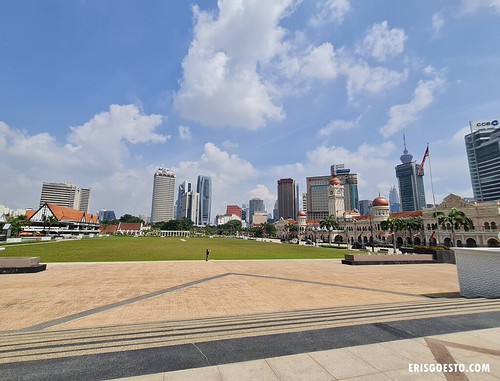
- The best exterior photos are from Merdeka Square across the road; the building is floodlit at night and the domes glow after dark.
- Jalan Raja is sometimes closed to traffic for events, and the area is fenced off before the National Day Parade on 31 August.
- The building is a popular wedding-photo location, especially at weekends; go early on a weekday for quieter corridors.
- Ask at the Visitor Centre about talks, exhibitions and events, which are announced on the BSAS website and social media.
Sultan Abdul Samad Building Location
Photos
Nearby
- Masjid Jamek Sultan Abdul Samad — Attraction, 0.1 km away
- River of Life at Masjid Jamek — Night view, 0.1 km away
- Merdeka Square (Dataran Merdeka) — Attraction, 0.1 km away
- River of Life and Blue Pool — Attraction, 0.2 km away
- National Textile Museum — Attraction, 0.2 km away
- St Mary's Cathedral — Temple, 0.3 km away
Plan a route with opening times using the Where2Go trip planner.
Frequently Asked Questions
Can you go inside the Sultan Abdul Samad Building?
Yes. Since 2 February 2026 the restored building has been open to the public daily from 8 am to 10 pm, with galleries, cafés and shops inside. Entry to the grounds and building is free.
How much is the Kuala Lumpur City Gallery at the Sultan Abdul Samad Building?
The Kuala Lumpur City Gallery is free for Malaysians, who collect a ticket at the Visitor Centre. Non-Malaysian visitors need a paid ticket, sold online through the official site. The Royal Selangor Gallery is free for everyone.
When was the Sultan Abdul Samad Building built?
The foundation stone was laid on 6 October 1894 and the building was completed and officially opened in April 1897. It was renamed after Sultan Abdul Samad of Selangor in 1974.
Who designed the Sultan Abdul Samad Building?
It is credited to State Architect A. C. Norman, but the final Indo-Saracenic design was largely the work of R. A. J. Bidwell under State Engineer C. E. Spooner, with contributions from A. B. Hubback.
What is the nearest station to the Sultan Abdul Samad Building?
Masjid Jamek LRT station is about a five-minute walk. Pasar Seni LRT/MRT station is about 10 minutes away on foot.
Sources
- Bangunan Sultan Abdul Samad (official site)
- BSAS Complex directory and getting here (official)
- Sultan Abdul Samad Building, Wikipedia
- How Bangunan Sultan Abdul Samad's legacy was given new life, Malay Mail
- Sultan Abdul Samad Building set for new role as city gallery, Malay Mail
- Bangunan Sultan Abdul Samad reopens with galleries and eateries, TheSmartLocal