
Masjid Jamek Sultan Abdul Samad, Kuala Lumpur
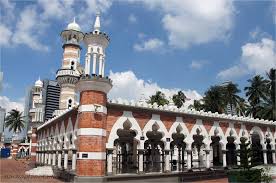
Masjid Jamek Sultan Abdul Samad, usually just called Masjid Jamek ("Friday mosque"), is the oldest surviving major mosque in Kuala Lumpur. It stands on the spit of land where the Klang and Gombak rivers meet, the spot where tin miners landed in 1857 and the city that took its name from this "muddy confluence" began. Designed by the government architect Arthur Benison Hubback and opened in 1909, it is a fine example of the Indo-Saracenic style, with red-brick and white-plaster minarets, onion domes and arcades of horseshoe arches. It is still a working mosque, and non-Muslim visitors are welcome outside prayer times, free of charge.
This guide covers the mosque's history, architecture, what you see on a visit, visiting hours and dress code (checked October 2026), how to get there and nearby sights.
| Address | Jalan Tun Perak, Kuala Lumpur |
|---|---|
| Hours | Non-Muslim visiting: about 10 am – 12:30 pm & 2:30 – 4 pm, Sat–Thu (closed to non-Muslim visitors Fri) |
| Take me here | |
| Verified | Verified October 2026 |
History of Masjid Jamek
By the early 1900s Kuala Lumpur had grown from a mining camp into the capital of the Federated Malay States, but its Muslim community still lacked a large central mosque. The site chosen was an old Malay burial ground on the point between the two rivers, the city's first Muslim cemetery. The foundation stone, of white Ipoh marble, was laid on 23 March 1908 by the Sultan of Selangor, Sultan Alaeddin Sulaiman Shah, and the mosque was officially opened on 23 December 1909.
Construction cost a little over 32,000 Straits dollars, paid partly by the Malay community and partly by the colonial government; the contractor was Towkay Ang Seng. The mosque could hold about 1,000 worshippers and served as Kuala Lumpur's principal mosque for more than half a century, until the National Mosque (Masjid Negara) opened in 1965.
The building has had a few close calls. It was damaged during a Japanese air raid on 26 September 1941, which killed three worshippers. In 1984 it was refurbished and the minaret nearest the river was underpinned because it had begun to lean, and in 1993 one of the domes collapsed after heavy rain and had to be rebuilt. Later extensions roofed over the forecourt that was originally open to the sky.
On 23 June 2017 the mosque was formally renamed Masjid Jamek Sultan Abdul Samad by the present Sultan of Selangor, Sultan Sharafuddin Idris Shah, in honour of Sultan Abdul Samad, the fourth Sultan of Selangor, who ruled when Kuala Lumpur was founded. Around the same time the riverbanks in front of the mosque were remodelled under the River of Life project, with new terraces, fountains and coloured night lighting; historic steps leading down to the river were uncovered and restored in 2014.
Architecture of Masjid Jamek
Hubback, who also designed the old Kuala Lumpur Railway Station and the building now used by the National Textile Museum, drew on the Mughal architecture of northern India rather than local Malay forms. The result, often described as Indo-Saracenic or "Mughal eclectic", has become one of the city's defining images:
- Three onion domes over the prayer hall, the largest rising 21.3 metres, with small chhatri pavilions at the corners. The domes are timber structures with a weatherproof covering rather than solid masonry.
- Two main minarets, each about 27 metres tall, with bands of red brick and white plaster sometimes nicknamed "blood and bandage" styling, plus a number of smaller turrets.
- Arcades of horseshoe and scalloped arches around the prayer hall and courtyard, which keep the interior shaded and cool.
- Cast-iron spiral staircases inside the minarets, made in England by the St Pancras Ironworks Company.
The mosque sits in a grove of palms with the two rivers on either side, and from the opposite banks it frames well against the modern towers behind it.
What to See at Masjid Jamek
- The prayer hall and courtyard: non-Muslim visitors can walk the courtyard and verandas and look into the prayer hall. A free guided tour can be requested at the entrance.
- The river view: walk to the end of the point or cross to the riverside promenade by Medan Pasar for the classic view of the domes over the confluence.
- River of Life at night: after dark the riverbanks are lit with coloured LED lighting and the fountains run. You see it from outside the mosque, so it works even when the mosque is closed to visitors.
- The LRT viewpoint: the raised platforms of Masjid Jamek LRT station look straight across at the mosque.
Masjid Jamek Visiting Hours and Dress Code
- Non-Muslim visiting hours: about 10 am to 12:30 pm and 2:30 to 4 pm, Saturday to Thursday. Some sources give the afternoon window as running to 4:30 pm; arrive by 4 pm to be safe.
- Closed to non-Muslim visitors: on Fridays, during the five daily prayers and on Islamic holy days. The mosque may also close at short notice for events.
- Admission: free.
- Dress code: long trousers or skirts and covered shoulders for everyone. Women are lent a robe and headscarf at the entrance, and men in shorts are given a robe. Shoes come off before entering.
- Time needed: 20 to 45 minutes.
How to Get to Masjid Jamek
- LRT: Masjid Jamek station, where the Kelana Jaya and Ampang/Sri Petaling lines meet, is right next to the mosque.
- MRT: Merdeka station (Kajang line) and Pasar Seni station are each about a 10-minute walk.
- Bus: several free GOKL city bus routes stop around Masjid Jamek and Medan Pasar.
- Grab or taxi: ask to be dropped on Jalan Tun Perak by the visitor entrance. Driving is not recommended; parking in the old town is scarce.
Tips for Visiting
- Combine the mosque with a heritage walk: Merdeka Square and the Sultan Abdul Samad Building are just across the river, the National Textile Museum is next to them, and Central Market and Chinatown are about ten minutes south.
- Go in the morning window for softer light on the domes and cooler air; the afternoon slot is short.
- Be respectful inside: speak quietly, do not walk in front of anyone praying and ask before photographing people.
- Bring a bag for your shoes or use the racks at the entrance.
- For food, the streets around Jalan Tun Perak and Jalan Masjid India have many mamak and Malay restaurants, and Medan Pasar has cafes in restored shophouses.
Masjid Jamek Location
Frequently Asked Questions
Can non-Muslims visit Masjid Jamek?
Yes. Non-Muslim visitors are welcome from about 10 am to 12:30 pm and 2:30 to 4 pm, Saturday to Thursday, outside prayer times. The mosque is closed to non-Muslim visitors on Fridays.
Is there an entrance fee for Masjid Jamek?
No. Entry is free, and a free guided tour can be requested at the entrance.
What should I wear to Masjid Jamek?
Cover your shoulders and legs. Women are lent a robe and headscarf at the entrance, men wearing shorts are given a robe, and everyone removes their shoes.
How old is Masjid Jamek?
The foundation stone was laid on 23 March 1908 and the mosque opened on 23 December 1909, making it one of the oldest mosques in Kuala Lumpur.
Who designed Masjid Jamek?
It was designed by the British government architect Arthur Benison Hubback in the Indo-Saracenic, Mughal-inspired style. He also designed the old Kuala Lumpur Railway Station.
Why was Masjid Jamek renamed?
On 23 June 2017 the Sultan of Selangor renamed it Masjid Jamek Sultan Abdul Samad, after the fourth Sultan of Selangor, who reigned when Kuala Lumpur was founded.