
National Textile Museum
Last updated: October 2026
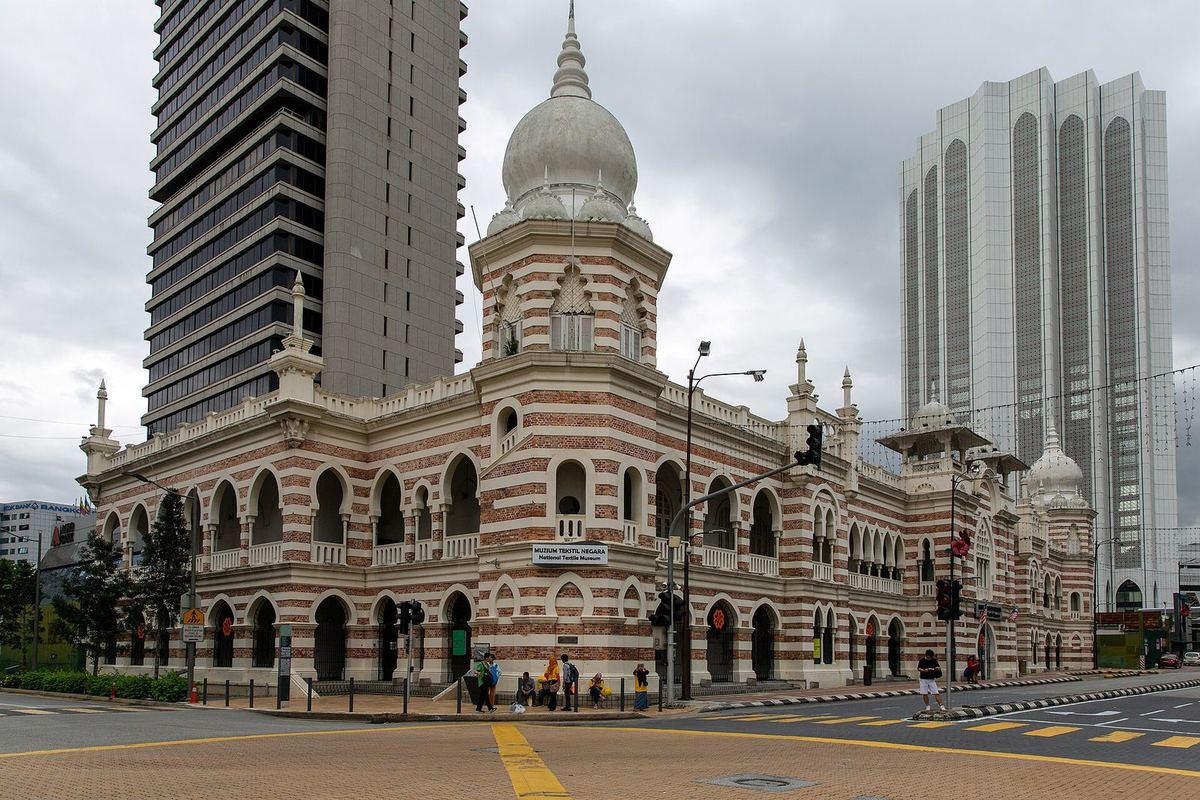
The National Textile Museum (Muzium Tekstil Negara) sits in a striped red-brick and white building on Jalan Sultan Hishamuddin, right beside the Sultan Abdul Samad Building and across the road from Merdeka Square. Run by the Department of Museums Malaysia (Jabatan Muzium Malaysia), it tells the story of Malaysian cloth and adornment, from bark cloth and back-strap looms to batik, gold-thread songket, Iban pua kumbu and Nyonya beadwork. It is small, cheap and well labelled in English and Malay, and it fits neatly into a walk around the old colonial core of Kuala Lumpur.
This guide covers the building's history, what is in each of the four galleries, tickets and hours (checked October 2026), how to get there and practical tips.
| Address | 26 Jalan Sultan Hishamuddin |
|---|---|
| Details | Daily 9 am – 5 pm (last ticket 4:30 pm) Malaysian adult RM2; non-Malaysian adult RM5 |
| Area | Dataran Merdeka |
| Typical visit | About 1 h |
| Listed in | Kuala Lumpur Attractions |
| Take me here | |
| Verified | Verified October 2026 |
History of the National Textile Museum Building
The building is older than the museum by more than a century. It was designed by Arthur Benison Hubback, the government architect behind several of Kuala Lumpur's best-known colonial landmarks, including Masjid Jamek and the old Kuala Lumpur Railway Station. It was completed in 1905 as the headquarters of the Federated Malay States Railways (FMSR), the forerunner of today's Keretapi Tanah Melayu (KTM). The Department of Museums' own page dates the site to 1896, but most published histories, including the museum volunteers' notes, give 1905 as the completion date.
Hubback worked in what is usually called the Indo-Saracenic or Neo-Mughal style: a British colonial take on Mughal and Moorish architecture from India. Here that means bands of red brick alternating with white plaster ("blood and bandages" banding), horseshoe and pointed arches, slender corner turrets and small onion domes. The building has two and a half storeys and a floor area of a little over 3,000 square metres. Its formal government name is still JKR 26, a reminder that it belonged to the Public Works Department (Jabatan Kerja Raya).
The railway administration moved out in 1917 to the larger Railway Administration Building opposite the Kuala Lumpur Railway Station, and the Jalan Sultan Hishamuddin building passed to the Selangor Public Works Department. Over the following decades it housed a long run of government offices: the Selangor Water Department, Bank Negara Malaysia (the central bank), Bank Pertanian (the Agricultural Bank), the Malaysian Handicraft Development Corporation (Kraftangan Malaysia) and, for a period, the High Court. It was gazetted as a historical building in 1983, which protects its facade and structure.
After restoration, the building reopened as the National Textile Museum on 9 January 2010.
What to See: the Four Galleries
The collection is arranged over two floors in four permanent galleries. The ground floor explains how cloth is made and how textile traditions spread; the upper floor concentrates on finished Malay textiles and on jewellery.
Pohon Budi Gallery (ground floor)
The introductory gallery traces textile making from prehistoric bark cloth to the present, with looms, tools and samples for each technique. Look out for the back-strap loom, which shows why early handwoven cloth was narrow (the width is limited by the weaver's own body), and the displays on calendering and gilding, gold-thread embroidery on velvet, Pahang royal weaving, songket looms, beading, tie-dye and the tools of batik making: the canting pen for hand-drawn wax lines and the copper block (cap) for stamped batik.
Pelangi Gallery (ground floor)
Pelangi means "rainbow" and the name doubles as the Malay term for a tie-dye cloth. This gallery shows the textiles of Malaysia's different communities. A large section covers batik, which developed on the east coast of the peninsula, mainly in Kelantan and Terengganu, from the 1930s as a local answer to expensive imported Javanese cloth. There are hand-drawn (batik tulis) and block-printed pieces, Baba and Nyonya textiles heavy with gold thread and beading, Indian-made cloth that reached the Malay world through trade, and ethnic textiles from Sabah and Sarawak, including the Iban pua kumbu, a warp-ikat ceremonial blanket whose motifs can tell stories and which, unlike songket, uses no gold thread.
Teluk Berantai Gallery (upper floor)
Named after the "interlocking bays" motif common in Malay design, this gallery is devoted to the most refined Malay textiles: songket (silk or cotton woven with supplementary gold or silver thread), kain limar (silk with weft-ikat patterns, often combined with songket borders) and tekat, the raised gold-thread embroidery used on pillow ends, wedding dais hangings and bridal decorations. Traditional costumes on mannequins show how these fabrics were worn at court and at weddings, and panels explain how tekat drew on embroidery traditions from India and China.
Ratna Sari Gallery (upper floor)
The last gallery switches from cloth to personal adornment: jewellery and accessories in gold, silver, copper, beads and feathers made by Malay, Chinese, Indian and Orang Asli craftspeople and by the indigenous peoples of Sabah and Sarawak. Highlights include pendant necklaces made to hold amulets, kerongsang brooch sets used to fasten the kebaya, rings, belts, bracelets, headdresses and a wedding crown coloured blue with kingfisher feathers.
The museum also hosts temporary exhibitions, often on a single textile (songket, batik or a particular region's weaving), and runs occasional workshops and demonstrations. The museum is on the Kuala Lumpur heritage trail, so it is easy to combine with the other colonial-era buildings on foot.
Tickets, Opening Hours and How Long to Spend
- Hours: daily 9 am to 5 pm, last ticket 4:30 pm. The museum closes for the first two days of Hari Raya Aidilfitri and the first day of Hari Raya Aidiladha.
- Tickets: Malaysian adults RM2; non-Malaysian adults RM5. Malaysian senior citizens and visitors with disabilities pay RM1. Children pay a reduced rate or nothing depending on age and nationality (Malaysian children under 12 are free).
- Time needed: about an hour is enough for all four galleries; textile enthusiasts can easily spend 90 minutes.
- Contact: 03-2694 3457 / 3461, or the museum's Facebook page (muziumtekstilnegara) for temporary closures and events.
How to Get to the National Textile Museum
- LRT: Masjid Jamek station (Kelana Jaya and Ampang/Sri Petaling lines) is the closest, about a five-minute walk via Jalan Tun Perak and across the river towards Merdeka Square.
- LRT/MRT Pasar Seni: about ten minutes on foot via Central Market and Jalan Hang Kasturi.
- KTM Komuter: Kuala Lumpur station on Jalan Sultan Hishamuddin is roughly a ten-minute walk to the south.
- Bus: the free GOKL city buses run through the old city centre; check the current route map for the nearest stop.
- Grab or taxi: ask for "Muzium Tekstil Negara, Jalan Sultan Hishamuddin". Parking is limited; the paid car park under Dataran Merdeka is the most practical option if you drive.
Tips for Visiting
- Go in the morning or mid-afternoon when the galleries are quiet, then walk to Merdeka Square, the Sultan Abdul Samad Building and Masjid Jamek, all within ten minutes.
- The galleries are air-conditioned, which makes the museum a good break from the midday heat on the heritage walk.
- Check the signs before taking photos, especially in temporary exhibitions, and never use flash near old textiles.
- The building is a century-old heritage structure, so check accessibility for the upper floor with staff on arrival if you use a wheelchair.
- For food, Central Market and Kasturi Walk are about five minutes away, and the Masjid Jamek area has plenty of mamak restaurants.
- If you want to buy batik or songket after your visit, Central Market (Pasar Seni) has several textile and craft shops.
National Textile Museum Location
Nearby
- Merdeka Square (Dataran Merdeka) — Night view, 0.1 km away
- Central Market (Pasar Seni) — Attraction, 0.2 km away
- Kasturi Walk — Souvenirs, 0.2 km away
- MaxMoney Lebuh Pudu — Money changer, 0.2 km away
- Restoran Yusoof dan Zakhir — Drinks, 0.2 km away
- Sultan Abdul Samad Building — Attraction, 0.2 km away
Plan a route with opening times using the Where2Go trip planner.
Frequently Asked Questions
How much is the National Textile Museum entrance fee?
Non-Malaysian adults pay RM5 and Malaysian adults RM2. Malaysian senior citizens and visitors with disabilities pay RM1, and children pay a reduced rate or enter free depending on age and nationality.
What are the National Textile Museum opening hours?
It is open daily from 9 am to 5 pm, with the last ticket sold at 4:30 pm. It closes on the first two days of Hari Raya Aidilfitri and the first day of Hari Raya Aidiladha.
What was the National Textile Museum building originally?
The building was completed in 1905 as the headquarters of the Federated Malay States Railways. It was designed by Arthur Benison Hubback and later housed government offices, a bank and the High Court before opening as a museum in 2010.
How long do I need at the National Textile Museum?
About an hour covers all four galleries. Allow 90 minutes if you want to read the panels on weaving, batik and gold-thread embroidery in detail.
What is the nearest station to the National Textile Museum?
Masjid Jamek LRT station is about a five-minute walk away. Pasar Seni LRT/MRT and the KTM Kuala Lumpur station are each about ten minutes on foot.