
Kampung Baru
Last updated: October 2026
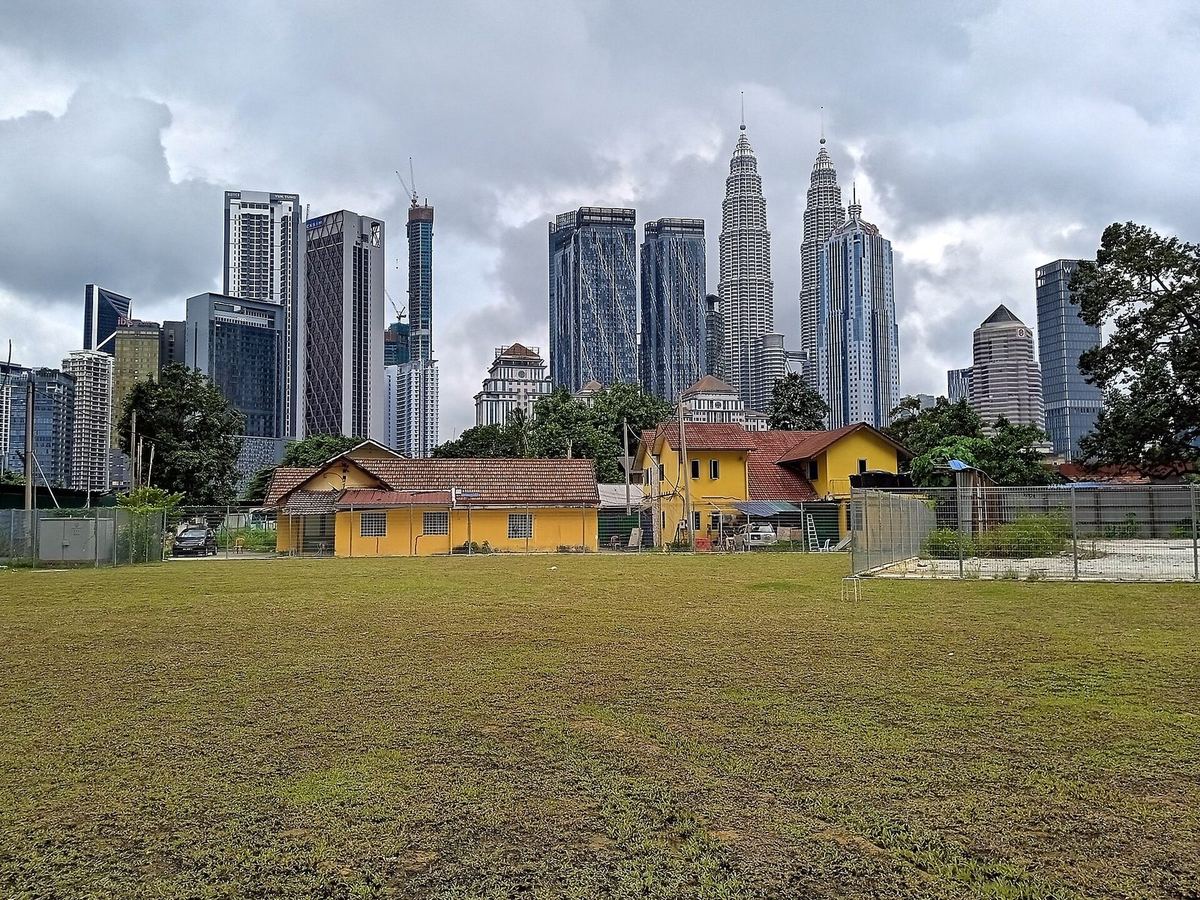
Kampung Baru is a Malay neighbourhood in the middle of Kuala Lumpur, just across the Klang River from the Petronas Twin Towers. It was set aside for Malay settlers in 1899, and although office towers now ring it on three sides, parts of it still look like a village: timber houses on stilts, fruit trees and frangipani in the gardens, small surau and a grand old mosque. It is also one of the best places in the city to eat Malay food, from breakfast nasi lemak to late-night satay. Walking around costs nothing, and an hour or two is enough to see the main sights.
This guide covers Kampung Baru's history, the buildings worth seeing, where and when to eat, how to get there and how to visit respectfully.
| Address | Kampung Baru, off Jalan Raja Abdullah |
|---|---|
| Details | Neighbourhood open 24 hours; food stalls mostly morning and evening Free |
| Area | Kampung Baru |
| Typical visit | About 1 h |
| Listed in | Kuala Lumpur Attractions |
| Take me here | |
| Verified | Verified October 2026 |
History of Kampung Baru
In 1899 the British administration of Selangor, with the consent of Sultan Alauddin Sulaiman Shah, set aside about 90 hectares of land between the Klang River and Batu Road (now Jalan Tuanku Abdul Rahman) as a settlement for Malays. It was formally gazetted as a Malay Agricultural Settlement (MAS) in the Selangor Government Gazette of 12 January 1900. The idea, associated with the Resident-General Frank Swettenham, was to give Malays a foothold in the fast-growing mining town, where they could farm and learn trade while keeping a village way of life.
The settlement was run by the Malay Agricultural Settlement Board, an 11-member body that first met on 11 March 1900. It was made up of seven villages: Kampung Periok, Kampung Masjid, Kampung Atas A, Kampung Atas B, Kampung Hujung Pasir, Kampung Paya and Kampung Pindah. Land could only be owned by Malays, a rule that still shapes the area today. By the 1928 census there were 544 houses and about 2,600 residents.
Kampung Baru played an outsized role in Malaysian politics. The Sultan Sulaiman Club, founded by residents in 1901, became the leading Malay social club in the capital; the Prince of Wales was received there during his 1922 tour, and in 1946 it hosted the Malay Congress that opposed the British Malayan Union plan and led to the founding of UMNO. The area was among the worst affected during the racial riots of 13 May 1969, and in 1998 it was a centre of the Reformasi street protests.
For decades, the government has tried to redevelop this valuable land close to KLCC. The Kampung Baru Development Corporation (Perbadanan Pembangunan Kampung Bharu) was set up to plan the change, and new towers have risen along the edges, but many families hold land jointly through several generations, and negotiations over compensation and heritage continue. That slow pace is why the village core has survived.
What to See in Kampung Baru
Traditional Malay houses
The houses are the main reason to walk around. Most are timber, raised on posts with steep roofs, verandas and carved fascia boards, and many have been extended over the years with brick ground floors. Two well-known examples are Rumah Limas, built in 1913 and one of the largest traditional houses left in the area (limas refers to its hipped, pyramid-like roof), and Master Mat's House, built in 1921 in a Malay-Palladian style on stone pillars for Ahmad Mohamed, a retired English-school headmaster. These are private homes, so view them from the road.
Sultan Sulaiman Club
At the corner of Jalan Raja Alang and Jalan Tuanku Abdul Rahman, the club's grounds hold a replica traditional timber building that opened as a gallery in 2007, with displays on Malay political history and the 1946 congress. The club is also the usual meeting point for guided walks of the village.
Masjid Jamek Kampung Baru
At the junction of Jalan Raja Alang and Jalan Raja Abdullah, Kampung Baru's main mosque began as a small prayer house of timber and bamboo and was later rebuilt in brick with a mix of Mughal and Malay features. It is the spiritual centre of the community and is packed for Friday prayers and during Ramadan.
Gurdwara Sahib Tatt Khalsa Diwan
On Jalan Raja Alang, on the edge of the village, this Sikh temple was built between 1922 and 1924 on about 0.8 hectares and is one of the largest gurdwaras in South-east Asia. Visitors are generally welcome; cover your head and remove your shoes.
Saloma Link and the KLCC view
The Saloma Link footbridge, opened on 5 February 2020, crosses the Klang River and the AKLEH expressway to link Kampung Baru with the KLCC side. It is named after the singer Saloma, who is buried in the nearby Muslim cemetery, and its design draws on the sireh junjung, a betel-leaf arrangement used at Malay weddings. At night its lit canopy and the twin towers behind make one of KL's best-known photographs. The bridge closes from about 1 am to 5 am.
Where and When to Eat
Kampung Baru is best known for its Malay food. Jalan Raja Muda Musa is the main eating street, with stalls and restaurants serving nasi lemak, nasi padang, ikan bakar (grilled fish), satay and kuih. Nasi Lemak Antarabangsa on Jalan Raja Muda Musa is one of the best-known names in the city for nasi lemak and has queues at breakfast. Jalan Raja Alang has shops selling jamu (herbal remedies), dates, Zam Zam water and religious goods.
Food is busiest at breakfast (about 7 to 10 am) and again in the evening. Almost all food here is halal, and many stalls take a break around Friday midday prayers.
Opening Hours, Cost and How Long to Spend
- Hours: it is a residential neighbourhood, so the streets are open at all times. Food stalls are mostly busy in the morning and evening.
- Cost: free to walk around; a meal at a stall usually costs well under RM20.
- Time needed: about an hour for a loop of the main streets, two hours with a meal or a guided walk.
How to Get to Kampung Baru
- LRT: Kampung Baru station on the Kelana Jaya Line is on Jalan Raja Abdullah, at the south-west edge of the area.
- MRT: Raja Uda station on the Putrajaya Line serves the north side.
- Monorail: Chow Kit station is a short walk to the west across Jalan Tuanku Abdul Rahman.
- From KLCC: walk over the Saloma Link bridge from Jalan Ampang/Persiaran KLCC; it takes about 10 minutes.
- Grab: ask for Jalan Raja Muda Musa for the food stalls. Street parking is tight, especially at dinner time.
Tips for Visiting Kampung Baru
- This is a living neighbourhood. Dress modestly (shoulders and knees covered is a good rule), keep noise down in the lanes and ask before photographing people or the inside of compounds.
- Non-Muslim visitors should not enter mosques during prayer times; outside them, ask at the entrance, and wear long sleeves and trousers or a long skirt. Women should cover their hair.
- Late afternoon is pleasant for walking, as the heat drops and the evening food stalls start to open; finish on the Saloma Link at dusk for the KLCC view.
- Guided heritage walks of the village have been run from the Sultan Sulaiman Club in the past; check current tour operators before you go if you want a guide.
- Pavements are uneven and some lanes have no footpath, so wear comfortable shoes and watch for motorcycles.
Kampung Baru Location
Nearby
- Hospital Pakar Al-Islam — Hospital, 0.2 km away
- AZ Dobi Layan Diri — Laundry, 0.3 km away
- Nasi Lemak Wanjo — Hawker food, 0.3 km away
- Gurdwara Sahib Tatt Khalsa Diwan — Temple, 0.3 km away
- Chow Kit Market — Attraction, 0.5 km away
- Kuih stalls at Bazaar Baru Chow Kit — Dessert, 0.5 km away
Plan a route with opening times using the Where2Go trip planner.
Frequently Asked Questions
Is Kampung Baru worth visiting?
Yes, especially if you want to see traditional Malay timber houses and eat Malay food in the city centre. It is free to walk around and sits right beside KLCC, so it is easy to combine with the Petronas Towers.
How old is Kampung Baru?
Land for the settlement was set aside in 1899 and it was gazetted as a Malay Agricultural Settlement on 12 January 1900, making it more than 125 years old.
How do I walk from KLCC to Kampung Baru?
Use the Saloma Link pedestrian bridge, which crosses the Klang River from the KLCC side. The walk takes about 10 minutes, and the bridge closes from about 1 am to 5 am.
What is the best time to visit Kampung Baru?
Go at breakfast for nasi lemak or in the late afternoon and evening, when it is cooler and the food stalls are busy. Stalls are quieter around Friday midday prayers.
Which station is nearest to Kampung Baru?
Kampung Baru LRT station on the Kelana Jaya Line is the closest. Raja Uda MRT and Chow Kit monorail stations are also within walking distance.