
Istana Negara (National Palace)
Last updated: October 2026
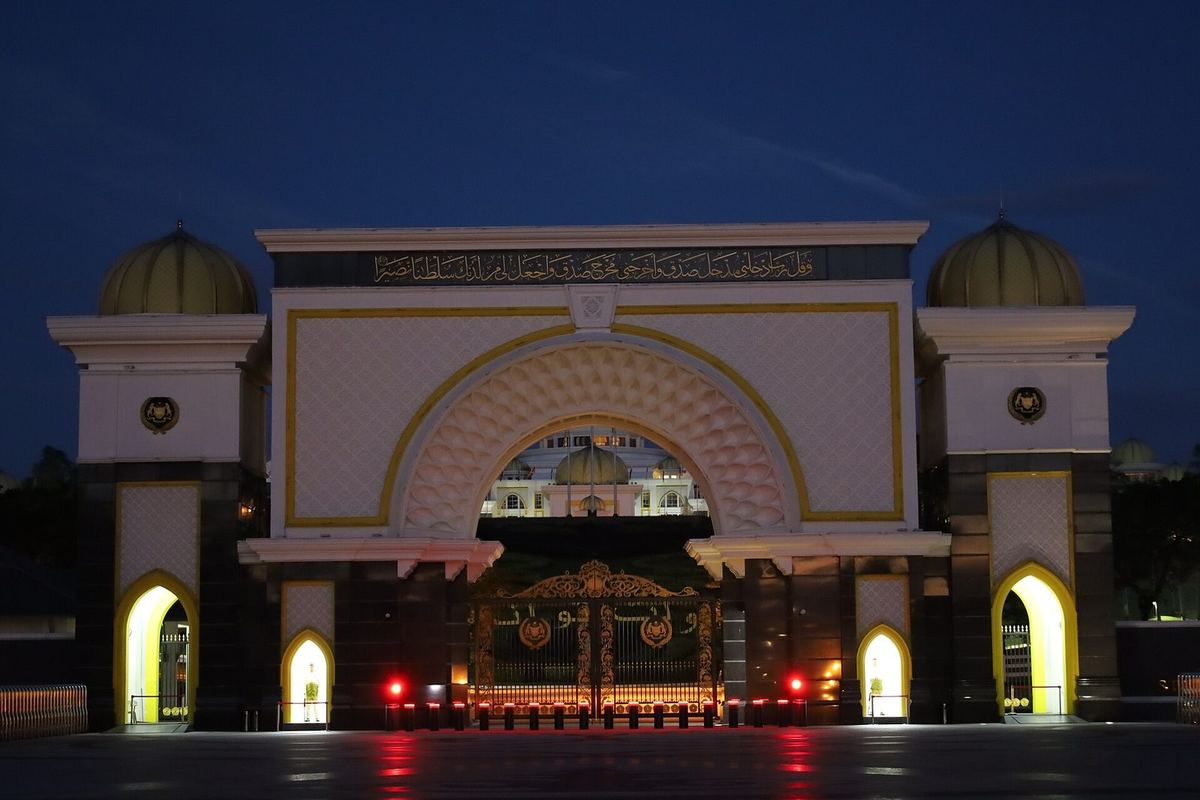
Istana Negara, the National Palace, is the official residence of the Yang di-Pertuan Agong, Malaysia's king. The present palace, on a hilltop off Jalan Tuanku Abdul Halim (formerly Jalan Duta) in north-western Kuala Lumpur, opened in 2011 and is crowned by 22 domes that are lit in changing colours at night. The palace grounds are closed to the public, but the main gate, with its mounted cavalry and sentries in ceremonial dress, is one of the city's best-known photo stops, and a few times a year it hosts a full Changing of the Guard ceremony.
This guide explains Malaysia's rotating monarchy, the history of both the new palace and the old Istana Negara on Jalan Istana, what visitors can see at the gate, and how to fit a visit into a day in Kuala Lumpur.
| Address | Jalan Tuanku Abdul Halim (formerly Jalan Duta) |
|---|---|
| Details | Main gate viewable from outside; grounds closed to the public Free |
| Opening hours | Exterior and main gate only |
| Changing of the Guard | Full ceremony two to three times a year, usually from 9 am, announced shortly before |
| Getting there | Grab or taxi (no rail station within easy walking distance) |
| Area | Jalan Duta |
| Typical visit | About 20 min |
| Listed in | Kuala Lumpur Attractions |
| Take me here | |
| Verified | Verified October 2026 |
Malaysia's Rotating Monarchy
Malaysia is one of the world's few elective monarchies. The office of Yang di-Pertuan Agong was created at independence in 1957. The king is elected by the Conference of Rulers, made up of the nine hereditary rulers of the Malay states, and serves a single five-year term, with the office in practice rotating among the nine. While he is king, a regent rules his home state. He is a constitutional monarch who acts mostly on the advice of the government, but he has some discretionary powers, such as appointing the prime minister and withholding consent to dissolve Parliament.
The current and 17th Yang di-Pertuan Agong is Sultan Ibrahim of Johor, who was elected on 26 October 2023 and sworn in at Istana Negara on 31 January 2024. His consort, the Raja Permaisuri Agong, is Raja Zarith Sofiah.
History of Istana Negara
The old palace on Jalan Istana (1957–2011)
For the first 54 years of independence, the king lived in a different building. The original Istana Negara on Jalan Istana, on the slope of Bukit Petaling above the Klang River, began life in 1928 as a two-storey mansion known as The Big House, built by the Chinese tin magnate Chan Wing. During the Japanese occupation it was the residence of the Japanese governor, and after the war the British Military Administration used it as a senior officers' mess. From 1950 the Selangor government rented it as the Sultan of Selangor's palace. In 1957 the federal government bought the 13-acre property for 1.4 million Malayan dollars and converted it into the palace of the new Yang di-Pertuan Agong. It was extended several times, most extensively in 1980, when the installation ceremony was held at the palace for the first time.
When the king moved to the new palace, the old Istana Negara became the Royal Museum (Muzium Diraja), which opened on 1 February 2013 and lets visitors see the throne room (Balai Rong Seri) and royal living quarters. The Department of Museums lists it as temporarily closed from 1 January 2026 until 31 January 2027, so check before planning a visit.
The new palace on Jalan Tuanku Abdul Halim (2011–)
The old palace had become too small: its throne room also had to serve as a dining and meeting hall. A new site in the Jalan Duta area had been set aside for a palace as far back as 1976, and Sultan Sirajuddin of Perlis, the 12th king, officiated at the new site on 13 November 2006. Construction began in November 2007 and cost RM812 million. The palace was designed by the architects Kumpulan Senireka and built by Maya Maju, with Islamic and Malay architectural elements, and was finished in September 2011, two years later than planned.
The palace administration began full operations on 11 November 2011, during the reign of Sultan Mizan Zainal Abidin of Terengganu, and the Royal Standard was raised on 15 November 2011 to mark it as the official National Palace. The first installation ceremony held there was that of Sultan Abdul Halim of Kedah, the 14th king, in 2012.
Inside the Palace Grounds
The complex covers 97.65 hectares on a hill, but only about 28 hectares are built on; the rest is kept as forest and a security buffer. It is divided into three parts: a formal section with the main throne room (Singgahsana), the banquet hall, audience halls and the chamber where the Conference of Rulers meets; a royal wing with the private residence, guest suites, library and gardens; and an administration section with offices, a helipad, horse stables and ceremonial cannons. Its 22 domes include two large ones shaped like neatly layered betel leaves, and the lighting on the domes changes colour depending on the function being held. There are three gates: the main ceremonial gateway off the Jalan Tuanku Abdul Halim flyover, a VIP entrance from Jalan Semantan–Dungun, and an entrance from Jalan Sri Hartamas for people with appointments and palace staff.
What Visitors Can See
The main gate
The public part of a visit is the forecourt at the main gate (Gate 1). Sentries in ceremonial uniform, sometimes joined by mounted troopers of the ceremonial cavalry squadron, are posted at the entrance during the day, and you can photograph them and the domes beyond from the marked public area. The guards stay still on duty; do not touch them or the horses, and do not cross the barriers.
The Changing of the Guard
The full Changing of the Guard ceremony takes place two to three times a year, when a new battalion takes over palace guard duties for a three- to six-month tour. It starts at about 9 am at Gate 1: the outgoing guard marches from the palace grounds to the main gate, the incoming guard forms up opposite, and the regimental colours are handed over to mark the changeover, accompanied by a military band. The November 2025 ceremony, for example, involved 9 officers and 164 soldiers of the 1st Battalion, Royal Malay Regiment, and 22 horses of the 21st Ceremonial Mounted Squadron. Dates are announced in the news shortly beforehand, and the public can watch from the area in front of the gate.
Opening Hours and Cost
- Grounds: closed to the public. Only the area outside the main gate is accessible.
- Gate viewing: free. Daylight hours are best for photos of the guards; the domes are lit at night.
- Time needed: 15 to 30 minutes at the gate, longer on Changing of the Guard days.
How to Get to Istana Negara
- Grab or taxi: the easiest option. Ask for "Istana Negara, Jalan Tuanku Abdul Halim, main gate". From the city centre the ride usually takes 15 to 25 minutes, depending on traffic.
- Public transport: no LRT or MRT station is within comfortable walking distance, and the roads around the palace are busy multi-lane routes with few pavements, so walking from a station is not recommended.
- Tours: most half-day Kuala Lumpur city tours stop briefly at the main gate, often combined with the National Mosque, the National Monument (Tugu Negara) and Perdana Botanical Gardens.
- Car: parking near the gate is very limited, so a Grab drop-off and pick-up is simpler.
Tips for Visiting
- Go in the morning, when it is cooler and the light is good for photos of the gate and domes.
- Dress neatly and behave respectfully: this is the working residence of the head of state. Follow any instructions from police or palace guards.
- Do not fly drones near the palace, and keep to the public area in front of the gate.
- Watch the news or official palace social media for Changing of the Guard dates and arrive early for a good spot.
- Pair the stop with nearby sights in the Lake Gardens area, such as the National Mosque, Perdana Botanical Gardens, the Islamic Arts Museum and the National Museum, which are 10 to 15 minutes away by car.
Istana Negara (National Palace) Location
Nearby
- Coffee Stain by Joseph — Cafe, 1.3 km away
- Masjid Wilayah Persekutuan (Federal Territory Mosque) — Temple, 1.5 km away
- JungleBird — Bar, 1.6 km away
- Three X Co — Bar, 1.8 km away
- Gulainya — Restaurant, 1.8 km away
- Global Doctors Hospital — Hospital, 2.0 km away
Plan a route with opening times using the Where2Go trip planner.
Frequently Asked Questions
Can you go inside Istana Negara?
No. The National Palace is the working residence of the King of Malaysia, and its grounds are closed to the public. Visitors can view and photograph the main gate and the ceremonial guards from outside.
When is the Changing of the Guard at Istana Negara?
The full ceremony is held two to three times a year, when a new battalion takes over guard duty, usually starting at about 9 am at the main gate. Dates are announced in the news shortly beforehand.
Who lives in Istana Negara?
The Yang di-Pertuan Agong, Malaysia's king, and the Raja Permaisuri Agong. Since 31 January 2024 the king has been Sultan Ibrahim of Johor, the 17th holder of the office.
When was the new Istana Negara built?
Construction began in November 2007 and the palace was completed in September 2011 at a cost of RM812 million. It became the official National Palace in November 2011, replacing the old palace on Jalan Istana.
Can I visit the old Istana Negara?
The old palace on Jalan Istana is now the Royal Museum (Muzium Diraja). The Department of Museums lists it as temporarily closed from 1 January 2026 until 31 January 2027.
How do I get to Istana Negara?
Take a Grab or taxi to the main gate on Jalan Tuanku Abdul Halim. There is no rail station within easy walking distance, and many city tours include a short stop there.
Sources
- Istana Negara, Jalan Tuanku Abdul Halim, Wikipedia
- Royal Museum (old Istana Negara), Wikipedia
- Muzium Diraja, Department of Museums Malaysia
- Yang di-Pertuan Agong, Wikipedia
- Changing of the Guard at Istana Negara showcases military tradition, New Straits Times
- Changing of the Guard ceremony at Istana Negara, Bernama