
Pinang Peranakan Mansion, Penang
The Pinang Peranakan Mansion is the mint-green townhouse at 29 Church Street (Lebuh Gereja) in the middle of George Town's UNESCO World Heritage Site. Built in the 1890s as the home and office of the tin magnate Kapitan Chung Keng Quee, it now operates as a private museum of Baba-Nyonya (Straits Chinese or Peranakan) life, with more than 1,000 antiques arranged through its halls, bedrooms, kitchen and courtyards. It is one of the most richly furnished interiors you can walk through in Penang, and one of the easiest heritage stops to reach on foot.
This guide covers the house's history, what to look for room by room, tickets and opening hours (checked October 2026), how to get there and practical tips for your visit.
| Address | 29 Church Street (Lebuh Gereja), George Town, 10200 Penang |
|---|---|
| Hours | Daily 9:30 am – 5 pm |
| Closed | Open every day including public holidays |
| Price | Adults RM25, children 6-12 RM12, under 6 free |
| Payment | Cash and card |
| Halal status | Not applicable (museum) |
| Getting there | Within George Town UNESCO zone. 5-minute walk from Lebuh Chulia. Street parking on Church Street. |
| Take me here | |
| Official site | pinangperanakanmansion.com.my |
| Verified | Verified October 2026 |
History of the Pinang Peranakan Mansion
Chung Keng Quee, the Kapitan who built it
The man behind the mansion was Chung Keng Quee (also spelt Chung Keng Kwee), a Hakka born in Guangdong in the 1820s who arrived in the Straits around 1841. He made his fortune in the Larut tin fields of Perak and by about 1860 led the Hai San, one of the two rival Chinese societies whose clashes became the Larut Wars (1861–1874). He was a signatory to the Pangkor Treaty of January 1874 that ended the fighting, after which the mining settlement of Larut was renamed Taiping, "everlasting peace". The British recognised him as Kapitan China (leader of the Chinese community) of Perak, he sat on the Perak State Council from 1877, and by the 1880s he was the largest tin producer in the state. He also gave the old mining pools that became the Taiping Lake Gardens.
Hai Kee Chan: building the house
Chung bought the Church Street plot in 1893 and commissioned the house that followed in the 1890s. He called it Hai Kee Chan (海记栈), usually translated as "Sea Remembrance Hall", and used it as both residence and business office. Although Chung was not Peranakan himself, his household and the style of the house reflect the wealthy Straits Chinese world of the period. The building was originally painted white.
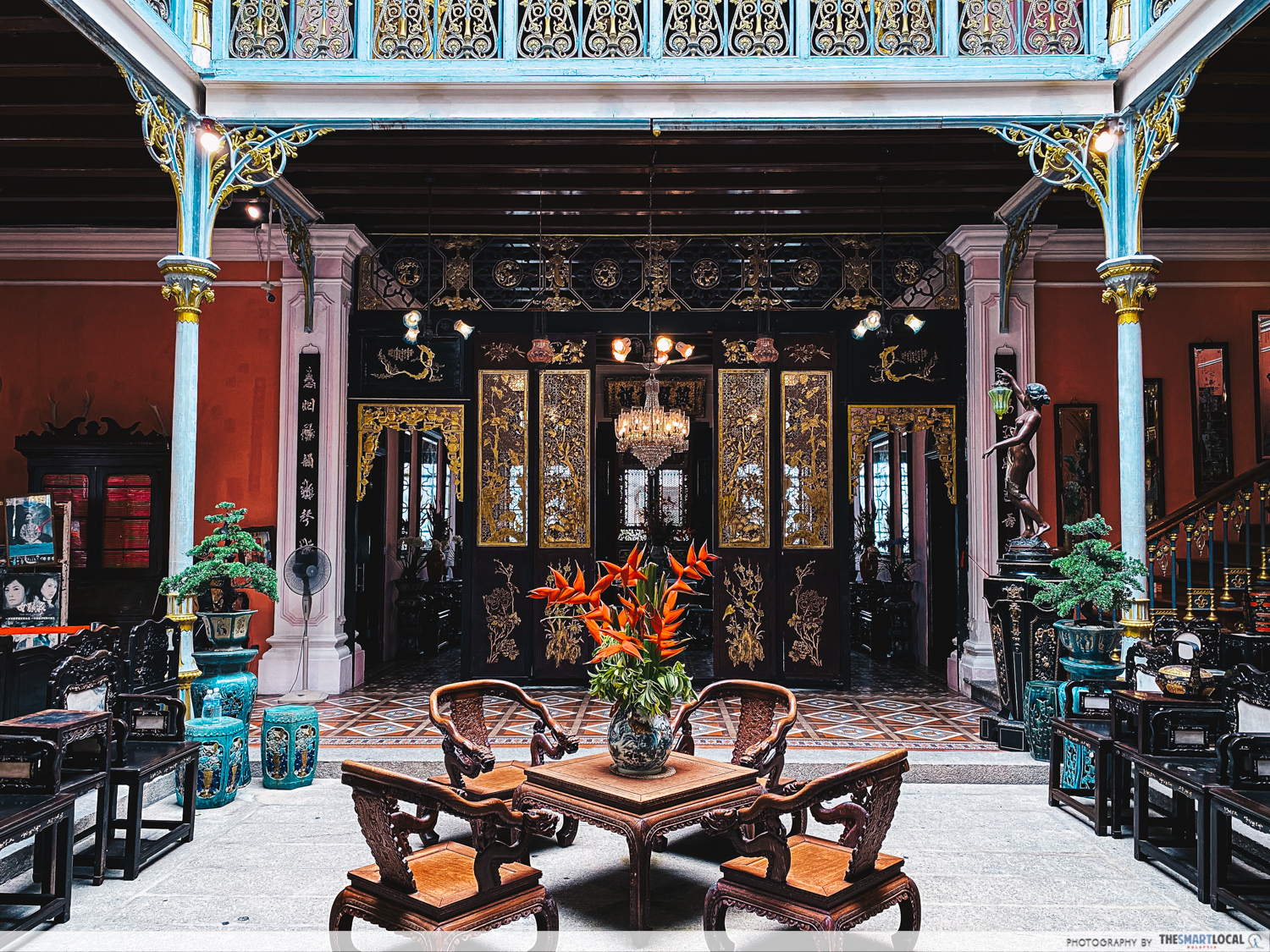
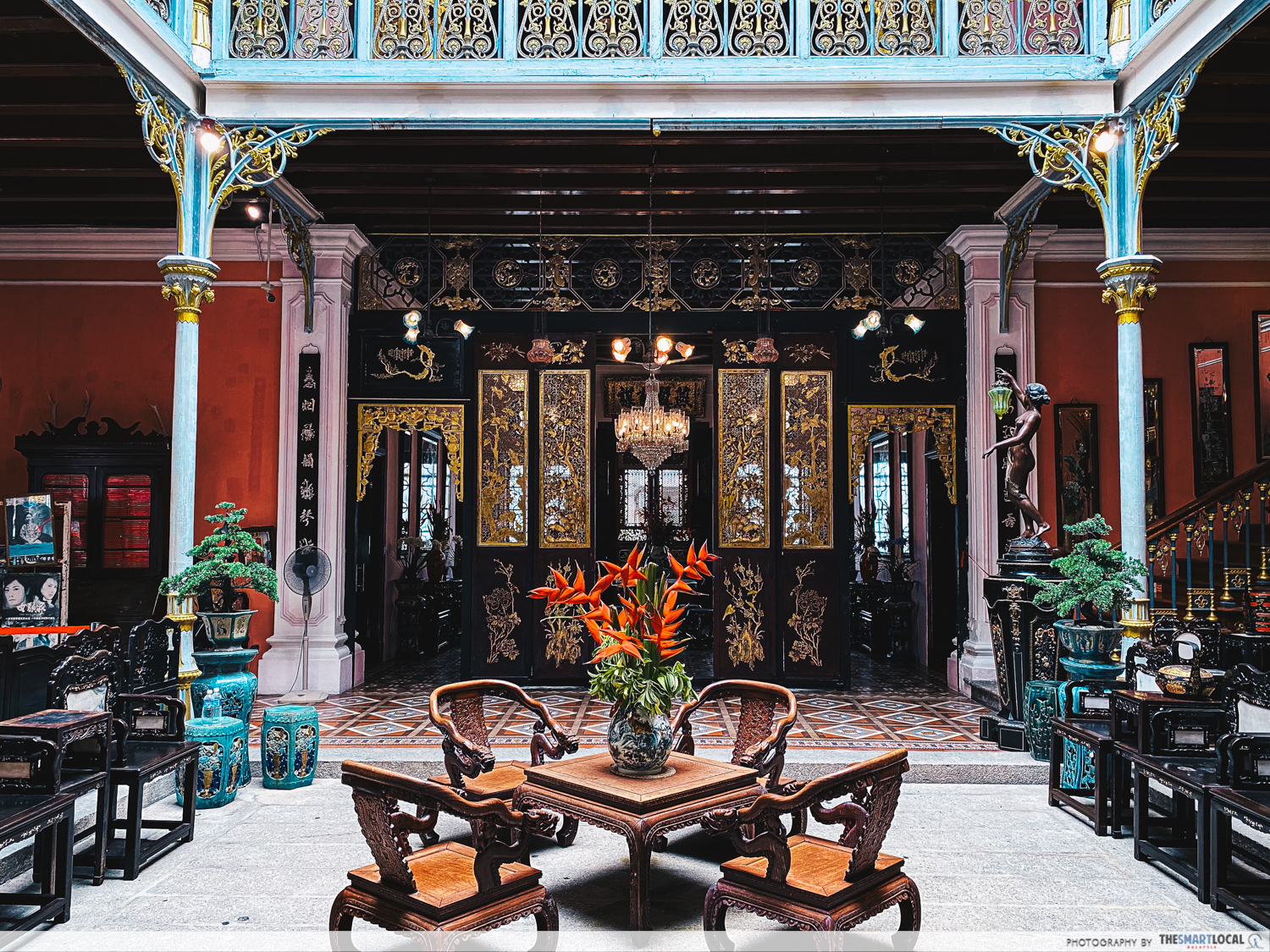
The architecture is Straits Eclectic: a Chinese courtyard-house plan with airwells and carved timber screens and panels, dressed with imported European materials. Ornamental cast iron came from Glasgow in Scotland, floor tiles from Stoke-on-Trent in England, and the fit-out used Italian marble, Burmese timber, French windows and Venetian mirrors. The five-foot way is indented along the side of the building rather than the front, an unusual arrangement for a George Town townhouse.
Decline and restoration
Chung died in December 1901 and was buried at Mount Erskine. The house passed to his descendants, but the family fortune faded, the building was taken over by the Japanese during the Second World War and afterwards stood largely empty for decades. In 2000 the Peranakan architect and antiques collector Peter Soon bought it from a fifth-generation descendant of the Kapitan. He restored the structure, painted it the green it is known for today and filled it with his own collection, gathered over some 30 years. The mansion opened as a museum in 2004 and is run privately by Pinang Peranakan Mansion Sdn Bhd.
Its interiors have since appeared on screen many times, including the Singapore drama The Little Nyonya (2008), several seasons of The Amazing Race and the film Crazy Rich Asians.
Who Were the Peranakan?
The Peranakan Chinese, or Baba-Nyonya, are descendants of Chinese traders who settled in Penang, Melaka and Singapore over several centuries and adopted many local Malay customs. Men were called Baba and women Nyonya. The community developed its own Malay-based patois, the kebaya and sarong dress, the beaded slipper (kasut manek), elaborate wedding rituals and Nyonya cooking, which mixes Chinese techniques with Malay spices. Under British rule many Peranakan families became wealthy merchants and English-educated professionals, and their homes mixed ancestral altars with Victorian furniture, which is the world this museum sets out to show.
What to See Inside
The museum is spread across the main house, a jewellery gallery, the kitchen and the ancestral temple next door. A single ticket covers all of them.
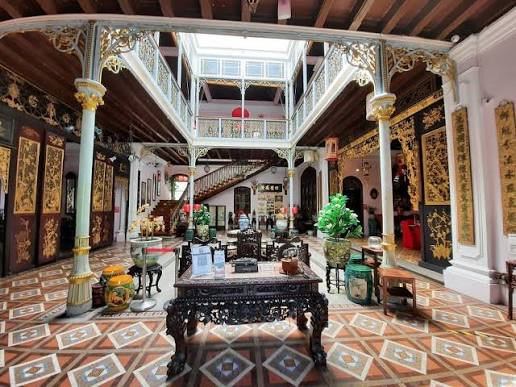
- The main hall and courtyard: the double-height central courtyard, with its cast-iron balustrades, carved and gilded timber screens and tiled floor, is the photograph most people come for. Look up at the ironwork brackets and down at the English tiles.
- Reception and dining rooms: rooms are set out with mother-of-pearl inlaid furniture, Victorian glass epergnes, chandeliers and tables laid with Nyonya porcelain in pink, green and yellow enamels.
- Bedrooms upstairs: antique brass and carved beds hung with embroidered textiles, along with beaded slippers, kebaya and period toiletries. The bridal chamber shows the preparations for a traditional Peranakan wedding.
- The kitchen: a recreated Nyonya kitchen with enamelware, stone mortars, brass pots and the moulds used for making kuih.
- Straits Chinese jewellery gallery: gold and diamond brooches (kerosang), belts, hairpins, headdresses and other personal ornaments that marked status and celebrations.
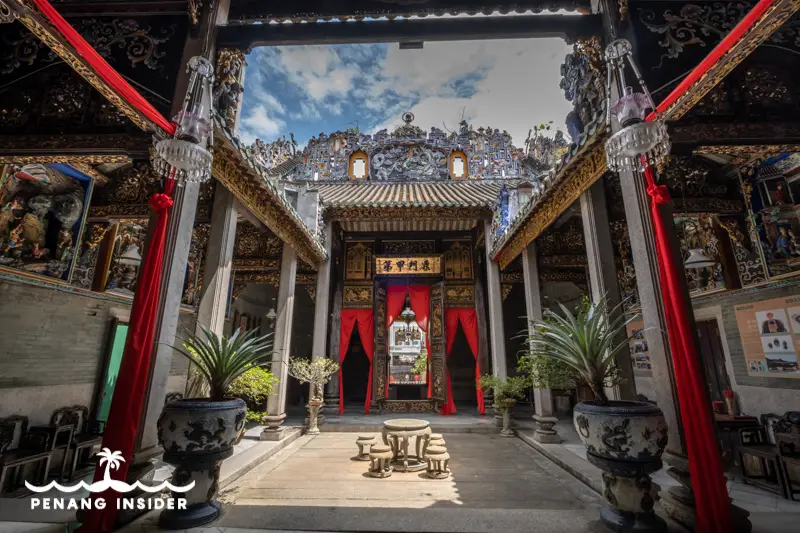
- Chung Keng Quee Ancestral Temple: the family temple beside the mansion holds a bust of the Kapitan by the English sculptor Benjamin Creswick, ancestral urns and fine carved and painted decoration. Descendants still gather here for prayers twice a year, so treat it with respect.
Look out also for smaller curiosities such as German bisque dolls, an early jukebox and the apothecary-style counter. Labels are fairly brief, so a guided tour adds a lot of context.
Pinang Peranakan Mansion Tickets, Hours and Tours
The mansion is open daily from 9:30 am to 5 pm. Admission is RM25 for adults and RM12 for children aged 6 to 12; children under 6 enter free. Cash and cards are accepted at the counter. Guided tours in English run at set times through the day and last around 45 minutes; ask at the ticket desk for the next one when you arrive, or book ahead if you are coming as a group. You are free to walk round on your own between tours.
Allow 45 minutes for a quick look and up to 90 minutes if you join a tour and visit the jewellery gallery and temple properly. Arrive by about 4:15 pm so you are not rushed at closing.
How to Get There
- On foot: Church Street runs between Lebuh Pantai (Beach Street) and Lebuh Kapitan Keling in the centre of the heritage zone. From Lebuh Chulia it is about a five-minute walk, and Little India and Kapitan Keling Mosque are about five minutes away.
- From the ferry and Weld Quay: the Swettenham Pier cruise terminal and the Pengkalan Sultan Abdul Halim ferry terminal are each roughly 10 to 15 minutes' walk away.
- Bus: Rapid Penang buses between Komtar and Weld Quay stop along Lebuh Chulia and Pengkalan Weld; the free CAT (Central Area Transit) shuttle loops through the heritage zone.
- Grab or taxi: ask for "Pinang Peranakan Mansion, Lebuh Gereja". The street is narrow, so drivers usually drop at the door and move on.
- Parking: limited metered street parking on Church Street and nearby lanes; arriving by Grab is easier.
Tips for Visiting
- Weekday mornings soon after 9:30 am are the quietest. Tour groups and cruise passengers arrive late morning, and the narrower upstairs rooms feel crowded at weekends.
- Photography is allowed in most areas, but use no flash near textiles and antiques, and do not touch or lean on furniture.
- Shoes come off before you go upstairs; wear socks if you dislike bare feet on old timber.
- The upper floor is reached by stairs only, so wheelchair users will be limited to the ground floor and courtyard.
- Dress is relaxed, but cover shoulders if you plan to spend time in the ancestral temple.
- Combine the visit with the Cheong Fatt Tze Blue Mansion, the other great Chinese mansion of the period, for a comparison of styles; then walk to Kapitan Keling Mosque and Little India for lunch.
- For Nyonya food after the museum, there are several Peranakan cafes and restaurants in the surrounding streets of the heritage zone.
Location
Photos
Nearby
- Cheong Fatt Tze Blue Mansion — 12-minute walk north on Lebuh Leith
- Chew Jetty — 10-minute walk south to Weld Quay
- ChinaHouse — 8-minute walk east to Beach Street
Frequently Asked Questions
How much is the Pinang Peranakan Mansion entrance fee?
Admission is RM25 for adults and RM12 for children aged 6 to 12. Children under 6 enter free, and one ticket covers the main house, the jewellery gallery, the kitchen and the ancestral temple.
What are the Pinang Peranakan Mansion opening hours?
It is open daily from 9:30 am to 5 pm, including weekends and most public holidays. Arrive by about 4:15 pm to see everything without rushing.
Who built the Pinang Peranakan Mansion?
It was built in the 1890s for Chung Keng Quee, the Hakka tin magnate and Kapitan China of Perak, who named it Hai Kee Chan. The architect and collector Peter Soon bought and restored it in 2000, and it opened as a museum in 2004.
How long do I need at the Pinang Peranakan Mansion?
Plan 45 minutes for a self-guided look and up to 90 minutes if you join a guided tour and spend time in the jewellery gallery and ancestral temple.
Are there guided tours at the Pinang Peranakan Mansion?
Yes. Guided tours in English run at set times during the day and take about 45 minutes. Ask at the ticket desk for the next start time, or book ahead for a group.
Can I take photos inside the Pinang Peranakan Mansion?
Photography is allowed in most of the house without flash. The courtyard and staircase are the most popular spots. Do not touch the furniture or displays.