
Kuan Yin Teng (Goddess of Mercy Temple), Penang
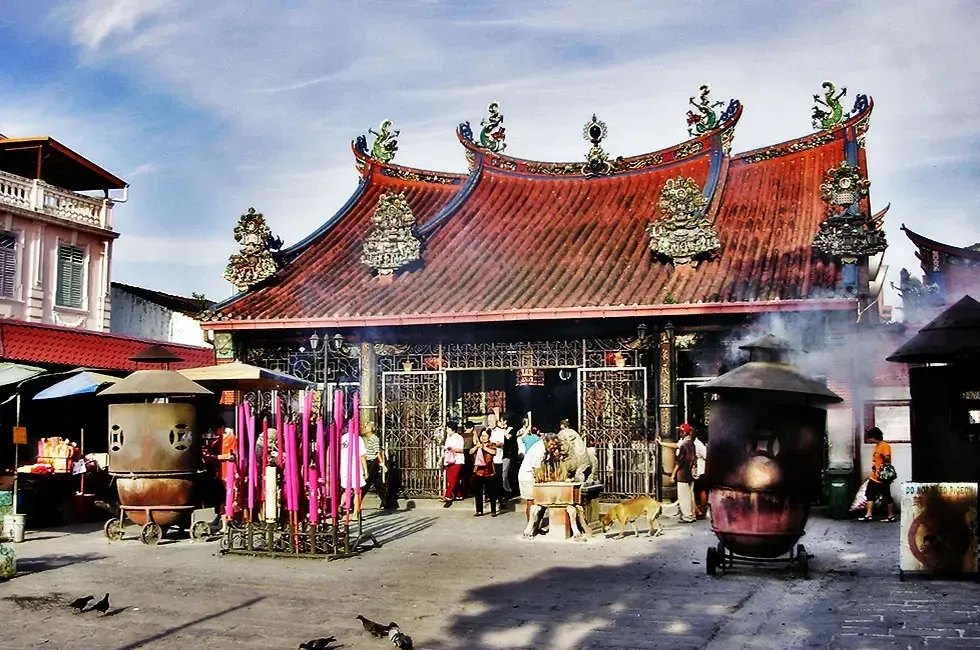
Kuan Yin Teng, the Goddess of Mercy Temple, is the oldest Chinese temple in Penang and one of the busiest. Its official name is Kong Hock Keong. It stands behind a wide paved courtyard on Jalan Masjid Kapitan Keling, the old Pitt Street, in the centre of George Town's UNESCO World Heritage Site. Founded around 1800, only 14 years after the British settlement began, it was for decades not just a place of worship but the meeting place, council and court of Penang's Chinese community. Today it is dedicated to Kuan Yin, the bodhisattva of compassion, and is rarely without worshippers lighting joss sticks in the courtyard.
This guide covers the temple's history, what to see, festival days and opening hours (checked October 2026), how to get there and etiquette for visitors.
| Address | Jalan Masjid Kapitan Keling (Pitt Street), George Town |
|---|---|
| Hours | Daily 6 am – 6 pm |
| Price | Free |
| Busiest days | 1st and 15th of each lunar month; Kuan Yin festivals on the 19th day of the 2nd, 6th and 9th lunar months |
| Take me here | |
| Verified | Verified October 2026 |
History of Kuan Yin Teng
A temple for the sea goddess, 1800
The temple was built in 1800 on land given by the British East India Company, at a reported cost of 4,000 Spanish dollars. Its first main deity was not Kuan Yin but Mazu (known locally as Ma Chor Poh), the goddess who protects sailors and seafarers, which reflects how many of the early Chinese settlers had arrived by sea and made their living from trade. The temple was supported jointly by the Hokkien and Cantonese communities, the two largest Chinese dialect groups in early George Town. Its official name, Kong Hock Keong, is usually translated as "Palace of Extensive Good Fortune", and the characters are also read as a reference to the Cantonese (Kong) and Hokkien (Hock) who ran it together.
Council and tribunal of the Chinese community
With an equal number of Hokkien and Cantonese representatives on its board, the temple acted as the community's council and tribunal into the mid-19th century, settling disputes and handling community affairs. In 1824 it was renovated and enlarged to house more deities, and two stone tablets put up by the temple board show that by then Kuan Yin had become the main deity. The change is often linked to the growing friction between the Hokkiens and the Cantonese in George Town at the time.
From the 1830s the influence of the temple declined as the clan associations built their own grand temples and kongsi, such as the Khoo Kongsi. After the Penang Riots of 1867, the secular role passed to the Penang Chinese Town Hall, founded around 1880 to 1881. In 1887 the monk Beow Lean became the temple's chief monk; a few years later he began building Kek Lok Si in Air Itam.
Survival and restoration
The temple came through the Japanese bombing and invasion of Penang in December 1941 unscathed, and survived several later incidents, including bombing and fire damage nearby in 1950 and 1964. Its most recent major restoration took place between about 2012 and 2017; as part of it, the old covered shelter over the courtyard was taken down around 2015, opening up the view of the temple front. In 2008 the temple became part of the core zone of the George Town UNESCO World Heritage Site.
What to See at Kuan Yin Teng
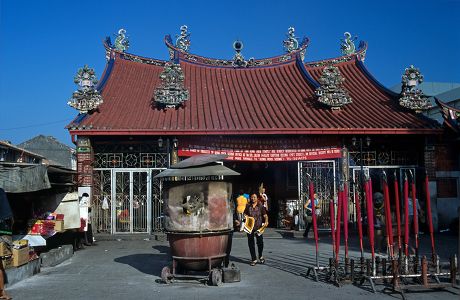
- The courtyard: the open square facing Jalan Masjid Kapitan Keling is where most of the activity happens, with large bronze urns and burners, giant joss sticks and worshippers praying towards the temple.
- The roof: the sweeping roof is decorated with dragon figures and jian nian work, a southern Chinese technique of making figures from fragments of cut porcelain.
- Doors and pillars: huge doors painted with Taoist and Buddhist deities, and dragon-entwined pillars that support the high roof.
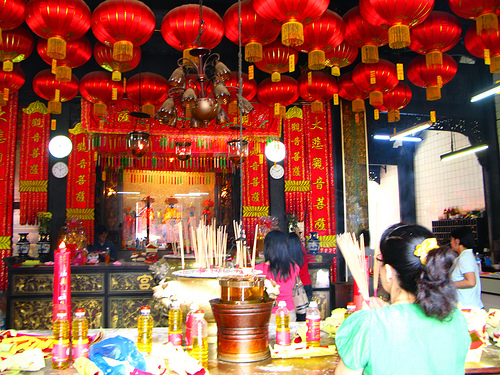
- The altars: the main altar holds the image of Kuan Yin, with Mazu on a side altar to the right. Other deities in the temple include Guan Yu, the god of war and loyalty, and Tua Pek Kong.
- The wells: the temple was laid out on a small rise according to feng shui principles. There are wells in the courtyard and inside the temple, and tradition holds that a third well lies hidden beneath the main altar, with water said to have healing properties.
- Fortune sticks: worshippers shake a container of 60 numbered sticks until one falls out, then collect the matching fortune slip.
Festivals at Kuan Yin Teng
- Kuan Yin festival days: the 19th day of the 2nd, 6th and 9th months of the Chinese lunar calendar mark the goddess's birth, her initiation and her attainment of enlightenment. These are the busiest days of the year, often with Chinese opera or puppet shows staged for the occasion.
- 1st and 15th of each lunar month: regular prayer days, when more worshippers come and offerings are brought.
- Chinese New Year and the Jade Emperor's Birthday: feast days that also bring large crowds of worshippers to the temple and courtyard.
Kuan Yin Teng Opening Hours and Entry
- Hours: daily 6 am to 6 pm.
- Entry: free.
- Time needed: 15 to 30 minutes.
- Dress code: no strict rule, but respectful clothing is appreciated.
How to Get to Kuan Yin Teng
- On foot: the temple is on Jalan Masjid Kapitan Keling, between St George's Church and Kapitan Keling Mosque. From the Weld Quay ferry terminal, walk up Lebuh China, about 10 minutes.
- Bus: the free CAT shuttle and several Rapid Penang routes run along Jalan Masjid Kapitan Keling and the nearby streets of the heritage zone.
- Grab or taxi: ask for "Kuan Yin Teng" or "Goddess of Mercy Temple, Jalan Masjid Kapitan Keling".
Tips for Visiting
- Come early in the morning, when the incense smoke is thick and regular worshippers are praying before work.
- Visitors can buy joss sticks at the stalls by the temple if they wish to make an offering.
- Do not stand directly in front of people who are praying, and ask before taking close-up photos of worshippers.
- Avoid festival days if you want a quiet visit, or go on purpose to see the temple at its busiest.
- The temple sits on the Street of Harmony; walk on to St George's Church, Sri Mahamariamman Temple and Kapitan Keling Mosque, all within a few minutes.
- Look out for the large mural "Penang: Past, Present and Future" nearby, and the Little India food stalls for breakfast.
Kuan Yin Teng Location
Photos
Kuan Yin Teng FAQ
How old is Kuan Yin Teng?
Kuan Yin Teng was founded around 1800, making it the oldest Chinese temple in Penang. It was renovated and enlarged in 1824, when Kuan Yin became its main deity.
What are Kuan Yin Teng opening hours?
The temple is open daily from 6 am to 6 pm. Entry is free.
Who is worshipped at Kuan Yin Teng?
The main deity is Kuan Yin, the Goddess of Mercy. Mazu, the sea goddess who was the temple's first main deity, has a side altar, and other deities include Guan Yu and Tua Pek Kong.
When is the busiest time at Kuan Yin Teng?
The temple is busiest on Kuan Yin's festival days, the 19th day of the 2nd, 6th and 9th lunar months, on the 1st and 15th of every lunar month and during Chinese New Year.
What does Kong Hock Keong mean?
Kong Hock Keong, the temple's official name, is usually translated as "Palace of Extensive Good Fortune". It is also read as a reference to the Cantonese and Hokkien communities who ran the temple together.