
Kek Lok Si Temple, Penang
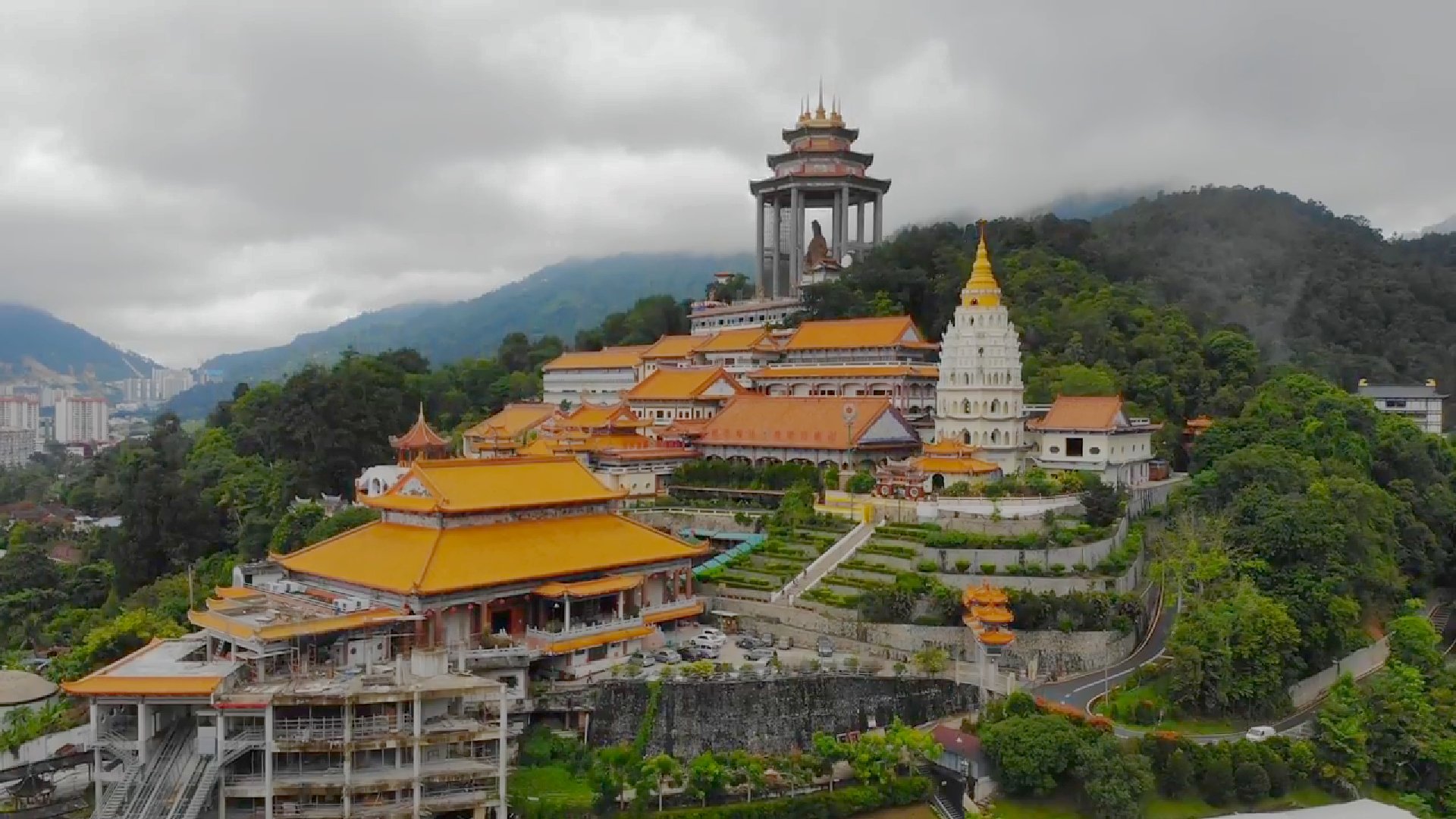
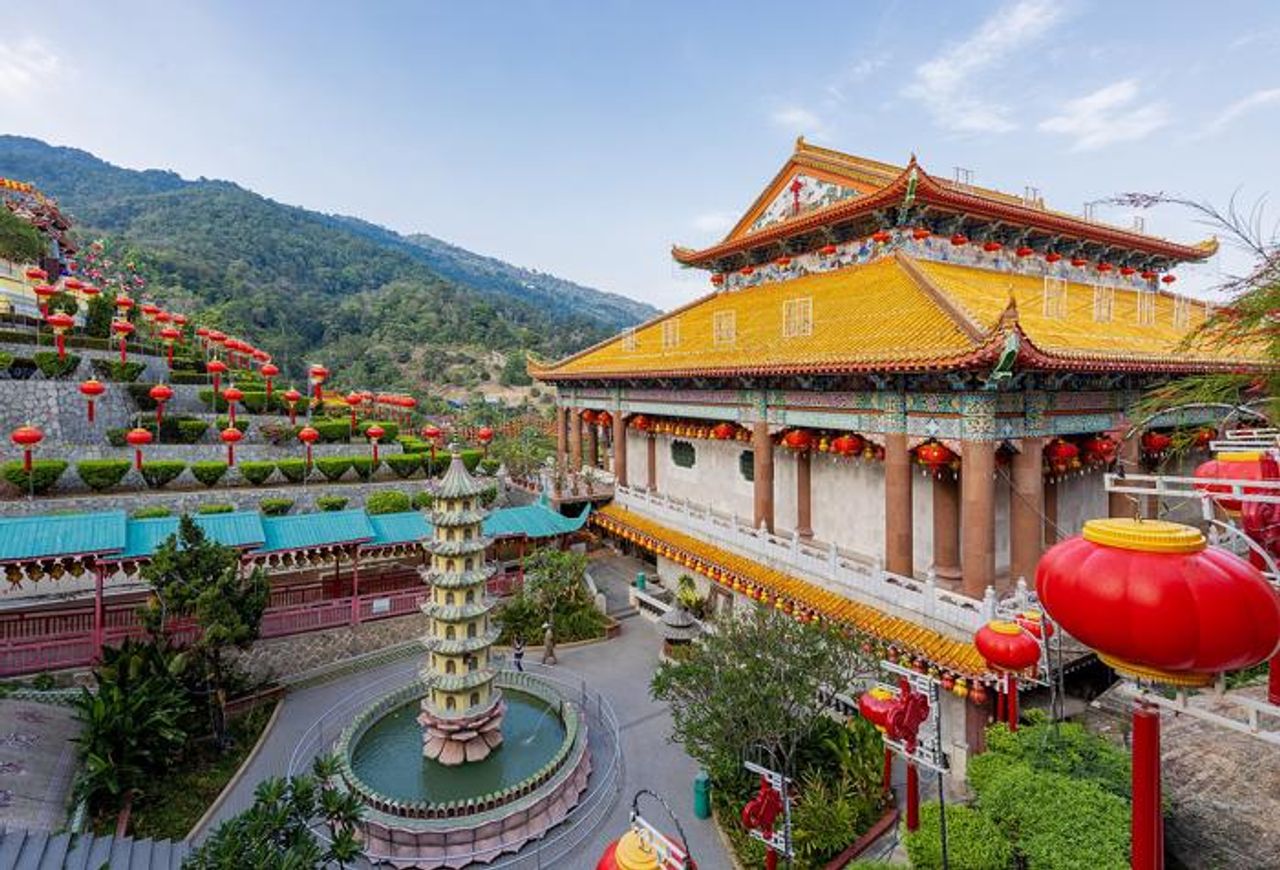
Kek Lok Si Temple, the "Temple of Supreme Bliss", climbs the slopes of Crane Hill above Air Itam, inland from George Town. It is the largest Buddhist temple in Malaysia: a hillside complex of prayer halls, courtyards, gardens and shrines on several tiers, crowned by the seven-storey Ban Po Thar pagoda and a 30-metre bronze statue of Kuan Yin, the Goddess of Mercy. Begun in 1890 by a Chinese monk with the backing of Penang's richest merchants, it is still an active monastery and one of the main pilgrimage sites for Chinese Buddhists in the region, as well as one of Penang's best-known sights.
This guide covers the temple's history, what to see on each level, fees and hours (checked October 2026), how to get there and tips for visiting.
| Address | Kek Lok Si Temple, Air Itam, 11500 Penang |
|---|---|
| Hours | Daily 8:30 am – 5:30 pm |
| Closed | Open every day including public holidays |
| Price | Free main grounds. Pagoda RM2. Inclined lift RM8 one way, RM16 return (children RM4 / RM8). |
| Payment | Cash only for pagoda and lift tickets |
| Halal status | Not applicable (place of worship) |
| Getting there | Rapid Penang bus 201, 203 or 204 to Air Itam market, then about 10 minutes' walk uphill. Paid car parks at the temple (about RM3). |
| Take me here | |
| Verified | Verified October 2026 |
History of Kek Lok Si Temple
Beow Lean and the founding
The temple's founder was Beow Lean, a Chan (Zen) Buddhist monk from Kushan (Gushan) Abbey near Fuzhou in Fujian, China. In 1887 he became chief monk of the Kuan Yin Teng (Goddess of Mercy Temple) on Pitt Street in George Town. Wanting to found a proper monastery in the hills, he began building on Crane Hill in Air Itam in 1890. The temple's name, Kek Lok Si in Hokkien, means "Temple of Supreme Bliss", the Chinese equivalent of Sukhavati, the Pure Land of the Buddhist scriptures.
The work was paid for largely by the leading Chinese businessmen of the Straits and Malaya, including the Hakka tycoons Cheong Fatt Tze, Chang Yu Nan, Cheah Choon Seng, Tye Kee Yoon and Chung Keng Kooi. The first phase of the main complex was completed in the early 1900s, around 1904 to 1905.
Imperial recognition
In 1904 the Chinese consul in Penang reported on the new monastery to the Qing court in Beijing. The Guangxu Emperor received Beow Lean, presented the temple with a large set of Buddhist scriptures and gave him the title of Chief Priest of Penang, with Kek Lok Si recognised as the head of the Chinese temples on the island.
The Pagoda of Ten Thousand Buddhas
The temple's most famous structure, the Ban Po Thar or Pagoda of Ten Thousand Buddhas, was begun in 1915 under the temple's second abbot, Ben Zhong, and the foundation stone was laid by King Vajiravudh (Rama VI) of Siam. The 30-metre, seven-storey pagoda was completed in 1930. Its design deliberately combines three Buddhist traditions: an octagonal Chinese base, a middle section in Thai style and a Burmese spiral crown at the top, reflecting the mix of Mahayana and Theravada Buddhism in Penang. Inside are around 10,000 Buddha images in alabaster and bronze, which give it its name.
The Kuan Yin statue and later growth
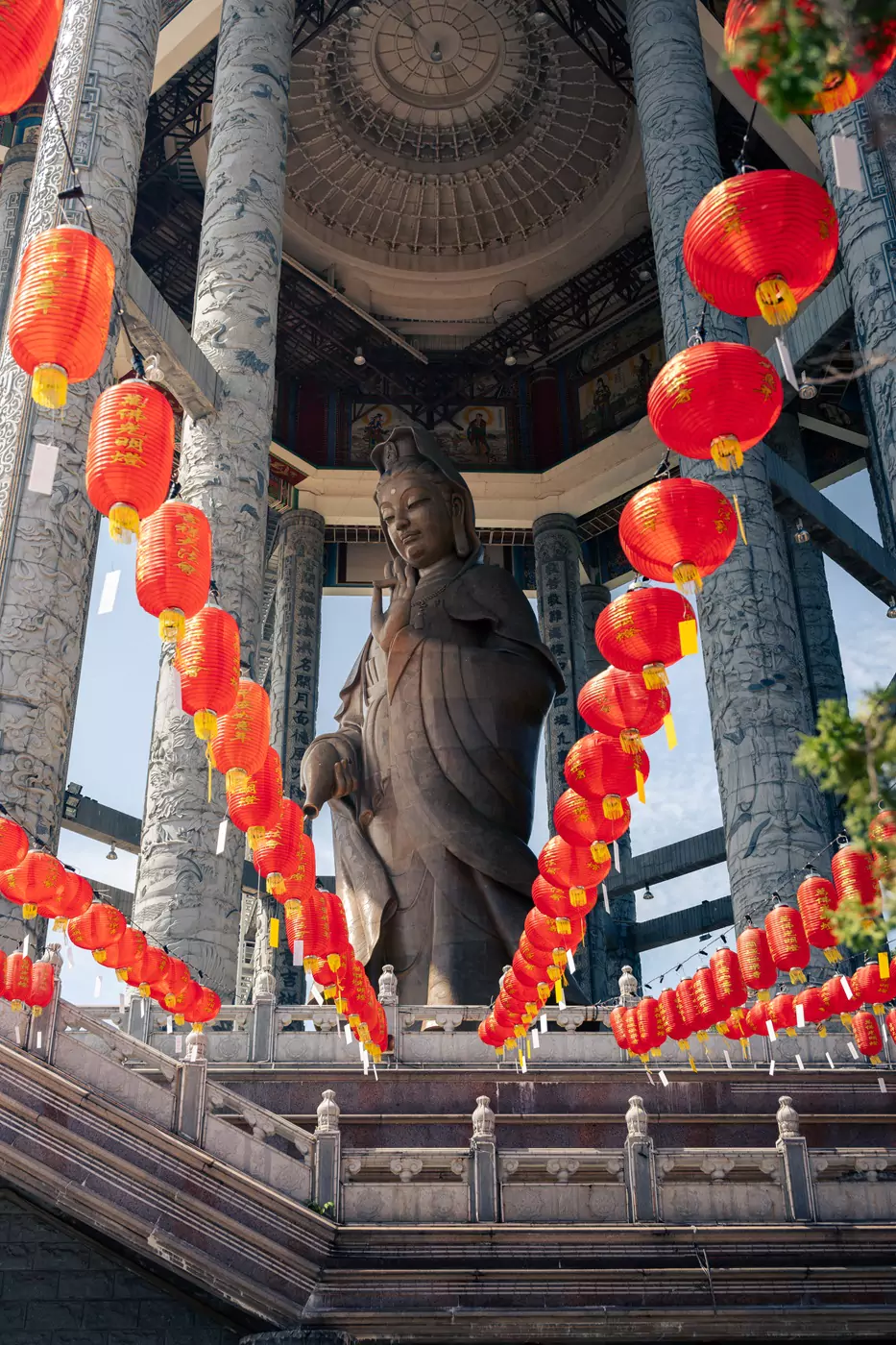
The temple has kept growing. An earlier white plaster statue of Kuan Yin on the upper slope was damaged by fire, and in 2002 a new bronze statue, 30.2 metres tall, was completed and opened to the public. A roofed pavilion supported by 16 bronze columns was built over it and completed in 2009, and around 100 smaller Kuan Yin statues, each about 2 metres tall, stand around it. The complex now covers about 12 hectares. Inclined lifts and buggies link the tiers, and the temple runs a charitable hospital in Air Itam, opened to mark its 130th anniversary. A fire in October 2021 damaged one small building but caused no injuries.
What to See at Kek Lok Si Temple
The complex is spread over three main tiers, so it helps to know the order. From the lower car park and Air Itam market, a covered walkway lined with souvenir and snack stalls leads up to the main gate.
Lower tier
- Liberation Pond (Tortoise Pond): just inside the gate, a pond crowded with tortoises and turtles released by devotees as an act of merit. Releasing animals here is part of the Buddhist practice of compassion for living beings.
- Hall of the Heavenly Kings (Tian Wang Dian): the entrance hall with large statues of the Four Heavenly Kings, each guarding one of the four points of the compass.
- Hall of the Laughing Buddha: a shrine to the cheerful, round-bellied Maitreya figure familiar from Chinese temples.
Middle tier
- Main Prayer Hall (Daxiongbao Dian): the principal shrine hall of the monastery, dedicated to the Buddha.
- Ban Po Thar pagoda: climb the narrow stairs inside the seven-storey pagoda (RM2) for the Buddha images on each level and views from the upper balconies over Air Itam, George Town and the sea.
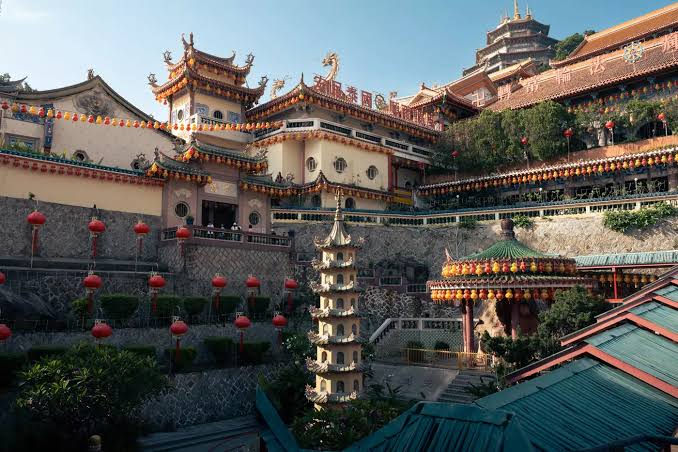
- Courtyards and gardens: terraces of ponds, flowering plants, smaller pagodas and shrines, with the zodiac garden and the columbarium nearby.
Upper tier
- Kuan Yin statue: reached by the inclined lift from the middle tier, the 30.2-metre bronze Goddess of Mercy stands under her tall pavilion, surrounded by rows of smaller statues. The terrace has wide views back over the temple roofs and the pagoda.
Chinese New Year light-up
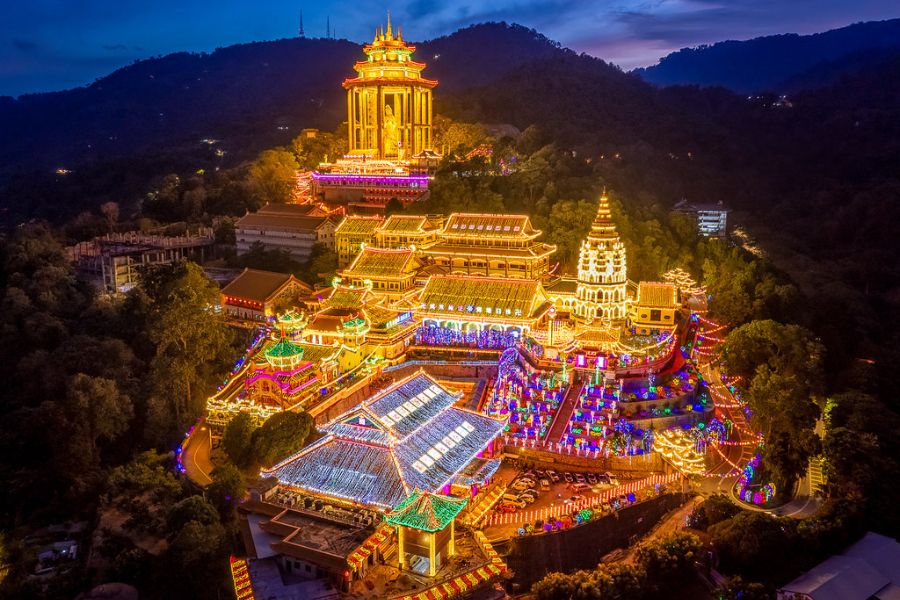
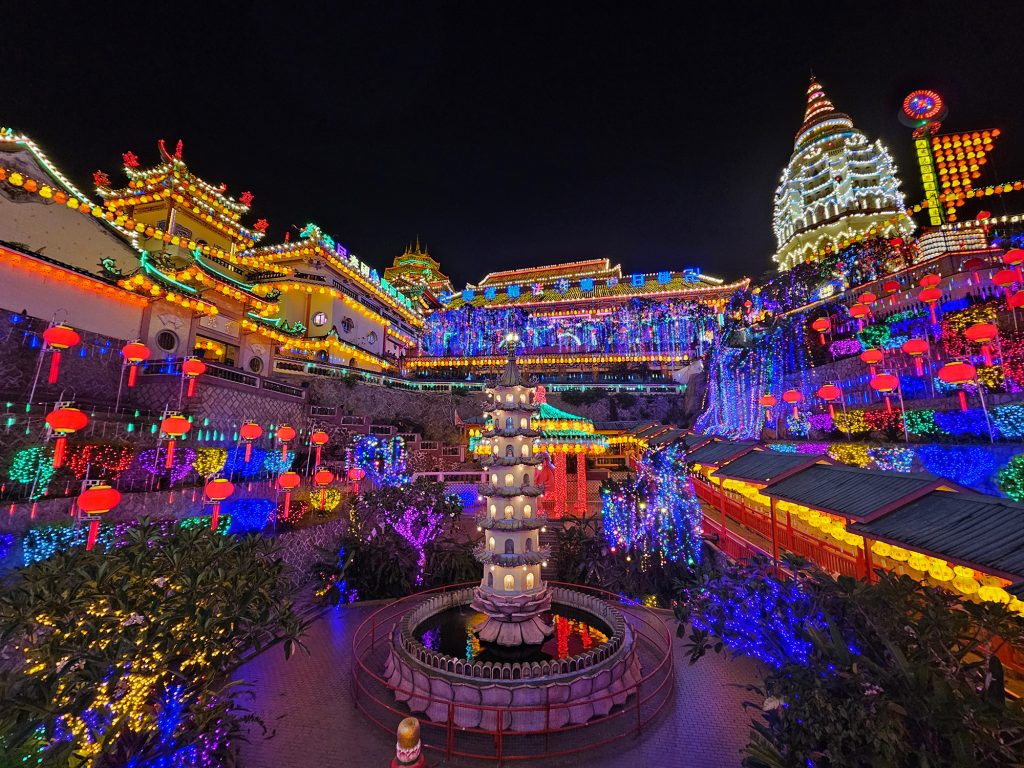
For about a month around Chinese New Year, the whole hillside is decorated with thousands of lanterns and lights paid for by devotees, and the temple stays open into the evening. It is the most spectacular and most crowded time to visit; arrive before dusk to see the lights come on.
Kek Lok Si Temple Fees, Opening Hours and How Long to Spend
- Hours: daily 8:30 am to 5:30 pm, including public holidays; hours are extended in the evening during the Chinese New Year light-up.
- Entry: the temple grounds are free.
- Pagoda: RM2 per person.
- Inclined lift to the Kuan Yin statue: RM8 one way or RM16 return for adults; RM4 one way or RM8 return for children. Older guides quote RM3 to RM6, so bring a little extra cash.
- Payment: cash for the pagoda and lift tickets.
- Time needed: 1.5 to 2 hours for the main halls, pagoda and Kuan Yin statue; up to 3 hours if you explore every terrace.
How to Get to Kek Lok Si Temple
- Bus: Rapid Penang buses 201, 203 and 204 run from KOMTAR and George Town to Air Itam. Get off at Air Itam market and follow the signs up the covered walkway, about 10 minutes uphill.
- Grab or taxi: about 15 to 25 minutes from George Town depending on traffic. Ask to be dropped at the upper car park to save the climb.
- Car: there are paid car parks at the temple (about RM3 per entry).
- With Penang Hill: the Penang Hill funicular lower station is about 3 km away, roughly 10 minutes by car, so the two are easy to combine.
Tips for Visiting
- Go early on a weekday morning. Tour groups and weekend crowds arrive from about 10 am.
- Dress respectfully, with shoulders and knees covered, and take off your shoes where asked before entering prayer halls.
- Wear comfortable shoes: even with the lifts there are many steps and slopes between the tiers.
- Keep your voice down and do not photograph worshippers or monks at close range without asking.
- Air Itam market at the foot of the hill is known for Air Itam laksa, a good lunch stop after the visit.
- The Chinese New Year light-up is very busy in the evenings; use Grab rather than driving, as parking fills up quickly.
Kek Lok Si Temple Location
Photos
Nearby
- Penang Hill — 10-minute drive to the funicular lower station
- Air Itam Laksa — 5-minute walk downhill at Pasar Air Itam
Read our in-depth guide to visiting Kek Lok Si: what is inside, what to do and what to buy.
Kek Lok Si Temple FAQ
Is Kek Lok Si Temple free to enter?
Yes, the temple grounds are free. The Ban Po Thar pagoda costs RM2, and the inclined lift to the Kuan Yin statue costs RM8 one way or RM16 return for adults.
What are Kek Lok Si Temple opening hours?
The temple is open daily from 8:30 am to 5:30 pm, including public holidays. During the Chinese New Year light-up it stays open into the evening.
How old is Kek Lok Si Temple?
Construction began in 1890 under the monk Beow Lean, and the first phase of the main complex was finished around 1904 to 1905. The Ban Po Thar pagoda was completed in 1930 and the bronze Kuan Yin statue in 2002.
How tall is the Kuan Yin statue at Kek Lok Si?
The bronze statue of Kuan Yin, the Goddess of Mercy, is 30.2 metres tall. It was completed in 2002 and its pavilion was finished in 2009.
What should I wear to Kek Lok Si Temple?
Dress modestly with shoulders and knees covered, and remove your shoes where asked before entering prayer halls. Comfortable walking shoes help, as there are many steps.
Can I combine Kek Lok Si Temple with Penang Hill?
Yes. The Penang Hill funicular lower station is about 3 km away, roughly 10 minutes by car, so many visitors do both in the same half day.