
George Town Street Art, Penang
George Town Street Art is the trail of painted murals and wrought-iron caricatures spread through the lanes of Penang's UNESCO World Heritage Site, with its busiest stretch on Armenian Street (Lebuh Armenian). The best-known pieces are the murals Lithuanian artist Ernest Zacharevic painted in 2012, such as the two children riding a real bicycle on Armenian Street, but the trail also includes 52 steel-rod cartoons installed in 2009 that tell the stories of individual streets, and dozens of later works by other artists. It is free, open at all hours and best explored on foot.
This guide covers how the street art began, the history of Armenian Street, where to find the main works, a suggested walking route and practical tips (checked October 2026).
| Address | Armenian Street, Ah Quee Street & surrounding lanes, George Town |
|---|---|
| Hours | Outdoor, open 24 hours |
| Price | Free |
| Typical visit | 1–2 hours on foot |
| Best time | Before 10 am or after 5 pm |
| Take me here | |
| Verified | Verified October 2026 |
History of George Town Street Art
Marking George Town (2009)
The first public art project to change the look of the heritage zone came soon after George Town was inscribed, with Melaka, as a UNESCO World Heritage Site in July 2008. In 2009 the Kuala Lumpur studio Sculpture At Work won a design competition called Marking George Town and went on to install 52 wrought-iron caricatures on walls across the old town. Each one is a cartoon drawn in steel rods with a short caption that explains something about the street where it hangs: a trade once practised there, a local character or a piece of folklore. Well-known examples include the "Jimmy Choo" piece on Lebuh Leith, "Kopi-O" on Lebuh Kimberley, the "Narrowest Five-Foot Way" on Lorong Stewart, "Escape" on Lebuh Acheh, and "Cheating Husband" on Love Lane.
Ernest Zacharevic and Mirrors George Town (2012)
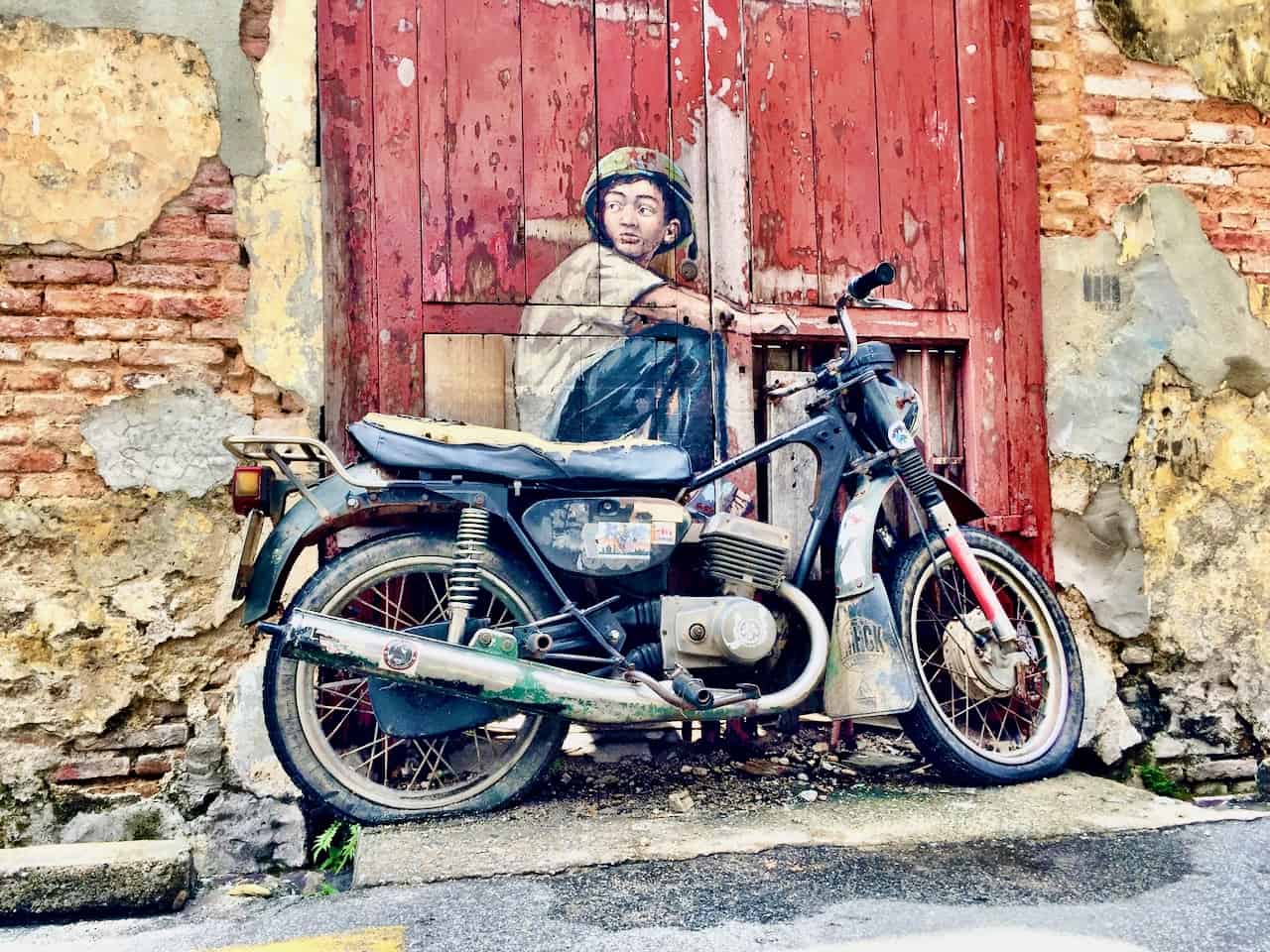
The murals that made the city famous came three years later. For the 2012 George Town Festival, the Penang state government commissioned Ernest Zacharevic, a young Lithuanian artist trained in London, to paint a series of murals under the title Mirrors George Town. Working in June and July 2012, he painted children and everyday characters on the walls of old shophouses, often combining paint with real objects fixed to the wall: a bicycle, a motorbike, a chair. The works were shared widely online and within a couple of years had turned the lanes around Armenian Street into one of Malaysia's most photographed places. Zacharevic stayed on in Penang and painted further pieces around the city, while other artists followed with murals of their own.
Later artists and the trail today
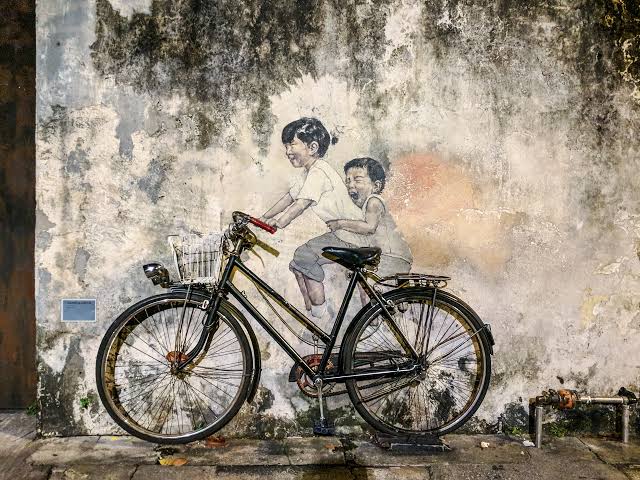
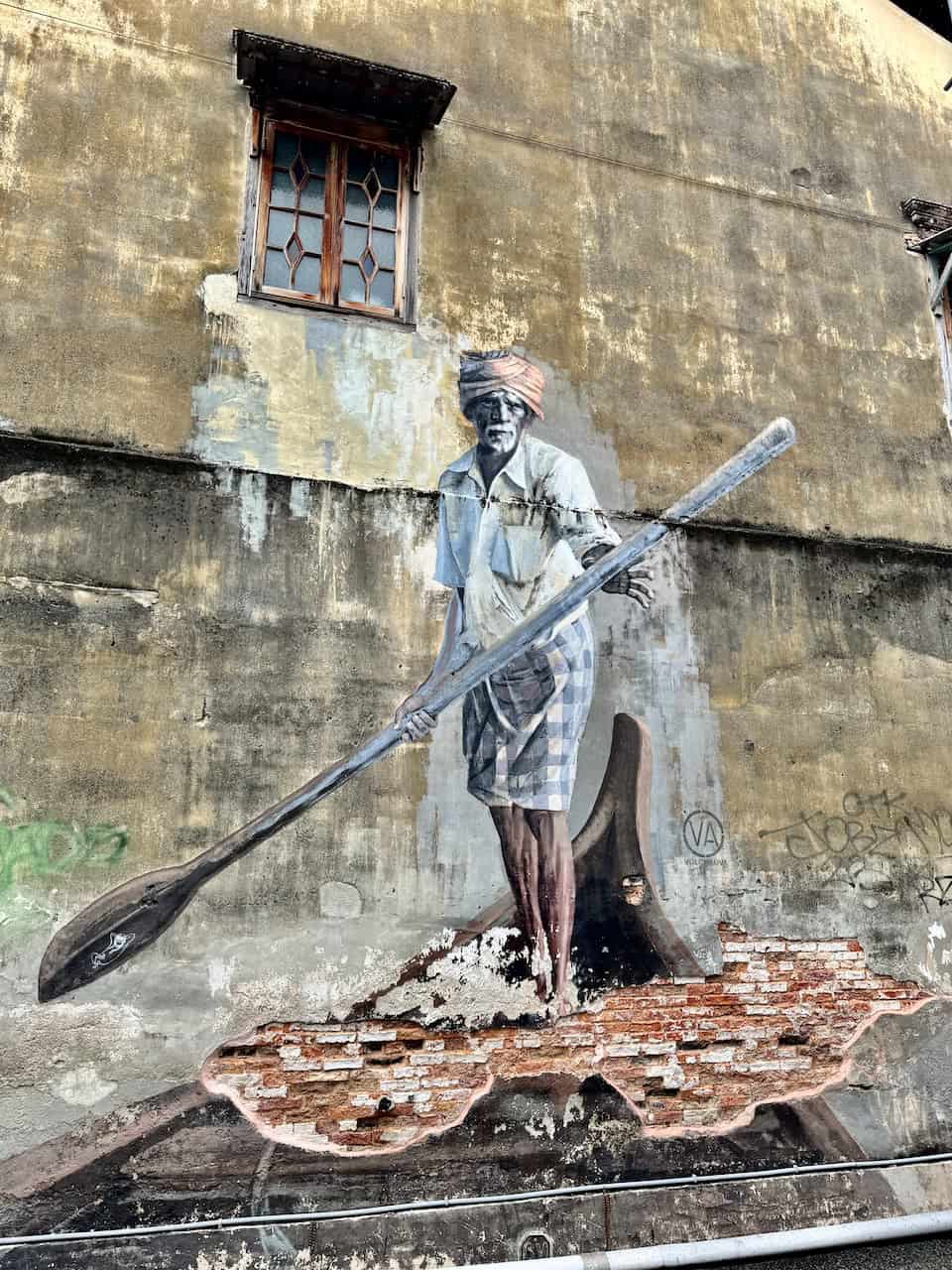
Among the best-known later works are "Brother and Sister on a Swing", by the self-taught Penang artist Louis Gan, which uses a real swing, and murals by the Russian artist Julia Volchkova, including portraits of an old Indian woman and an Indian boatman near Stewart Lane. Some early murals have faded in the sun and rain or been damaged, and a few have been painted over as buildings changed hands. "Little Children on a Bicycle" was retouched in 2016 and is periodically maintained.
Armenian Street: A Short History
Armenian Street is one of the oldest streets in George Town. It was first called Malay Lane, after a Malay settlement in the area, and was renamed by about 1808 after the Armenian traders who lived and did business along it. The Armenian community built St Gregory's Church nearby in 1822, and the Armenian Sarkies brothers later founded the Eastern & Oriental Hotel in the 1880s, but most Armenians had left Penang by the time the church was demolished in 1937. The street saw heavy fighting during the Penang Riots of 1867, a clash between rival secret societies. In 1910 Dr Sun Yat Sen chaired the Penang Conference at a townhouse here, now the Sun Yat Sen Museum, to plan and fund the uprising in Canton that preceded the fall of the Qing dynasty. Clan houses such as the Yap Kongsi and Cheah Kongsi stand on the street, and Khoo Kongsi is just behind it on Cannon Square.
Where to Find the Main Works
Ernest Zacharevic's 2012 murals
- Little Children on a Bicycle: Armenian Street, near the junction with Lebuh Cannon. Two children ride a real bicycle; the queue for photos is longest here.
- Boy on a Bike (The Boy and his Motorbike): Lebuh Ah Quee, with a real old motorbike fixed in front of the wall.
- Little Boy with Pet Dinosaur: opposite the motorbike mural, off Lebuh Ah Quee.
- Little Girl in Blue (Kung Fu Girl): Muntri Street, a girl climbing between two windows.
- Boy on a Chair: Lebuh Cannon, about 200 metres from the bicycle mural.
- Trishaw Man: the largest of the series, by the Red Garden food court car park.
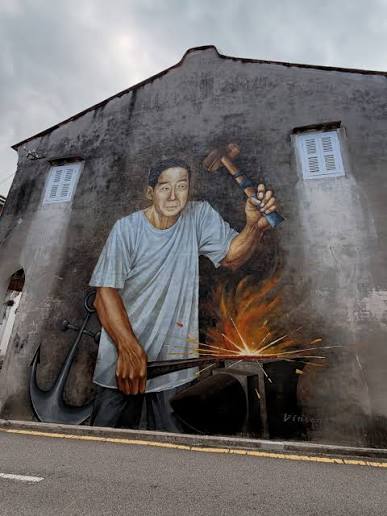
- Uncle Ng, the Clog Maker: Armenian Street; one of the works most affected by fading.
Other works worth finding
- Brother and Sister on a Swing by Louis Gan, with a real swing.
- Reaching Up, a boy stretching up the wall at the corner of Lebuh Chulia and Lebuh Cannon.
- Marking George Town caricatures such as "Jimmy Choo" (Lebuh Leith), "Kopi-O" (Lebuh Kimberley), "Narrowest Five-Foot Way" (Lorong Stewart) and "Bullock Cart Wheel" (Jalan Masjid Kapitan Keling). Look for the steel-rod cartoons on corner walls as you walk.
Suggested Walking Route
A loop of about two kilometres covers the main works in one to two hours, including photo stops:
- Start on Armenian Street at the bicycle mural and look at the clan houses and Sun Yat Sen Museum along the street.
- Walk to Cannon Square for Khoo Kongsi and the Boy on a Chair mural on Lebuh Cannon.
- Head to the corner of Lebuh Chulia and Lebuh Cannon for Reaching Up, then east along Lebuh Ah Quee for the motorbike and dinosaur murals.
- Cut north to Muntri Street for the Little Girl in Blue, then west to Love Lane and Lorong Stewart for the caricatures.
- Finish at the Red Garden food court for the Trishaw Man mural and an evening meal.
Murals change: new pieces appear and old ones fade, so it helps to pick up a current street art map from your hotel or a heritage centre, or check the latest locations on Google Maps before setting off.
Tips for Visiting
- Go before 10 am or after 5 pm. The light is softer, the lanes are cooler and the queues at the bicycle and motorbike murals are much shorter.
- Wait your turn at the popular murals and do not climb on the real objects fixed to the walls; several have been damaged by visitors.
- These are people's homes and businesses. Keep doorways clear, keep noise down in residential lanes and ask before photographing shopkeepers.
- Wear comfortable shoes and carry water; most lanes have little shade, and five-foot ways can be uneven for wheelchairs and pushchairs.
- Hire a bicycle or join a trishaw tour if you prefer not to walk the whole route in the heat.
- Duck into the Sun Yat Sen Museum, Khoo Kongsi or the Asia Camera Museum for an air-conditioned break, and stop for coffee, ice kacang or cendol along Armenian Street.
Location
Photos
Frequently Asked Questions
Where is the famous George Town street art?
The best-known murals are on and around Armenian Street (Lebuh Armenian), Lebuh Cannon, Lebuh Ah Quee, Muntri Street and Lebuh Chulia, all in the George Town UNESCO heritage zone and within walking distance of one another.
Who painted the Children on a Bicycle mural?
Lithuanian artist Ernest Zacharevic painted it in 2012 as part of the Mirrors George Town project for the George Town Festival. The children ride a real bicycle fixed to the wall on Armenian Street.
Is George Town street art free to see?
Yes. All the murals and iron caricatures are on public streets, free and accessible at any time of day.
What are the iron sculptures on George Town walls?
They are the 52 Marking George Town caricatures made from steel rods by the studio Sculpture At Work in 2009. Each one explains a piece of history or local life linked to the street where it is mounted.
How long does the George Town street art walk take?
Allow one to two hours for a loop of about two kilometres covering the main Zacharevic murals and a selection of the iron caricatures.
What is the best time to photograph George Town street art?
Early morning before 10 am is best, when queues are short and the light is soft. Late afternoon after 5 pm is the next best option.