
Asia Camera Museum
Last updated: October 2026
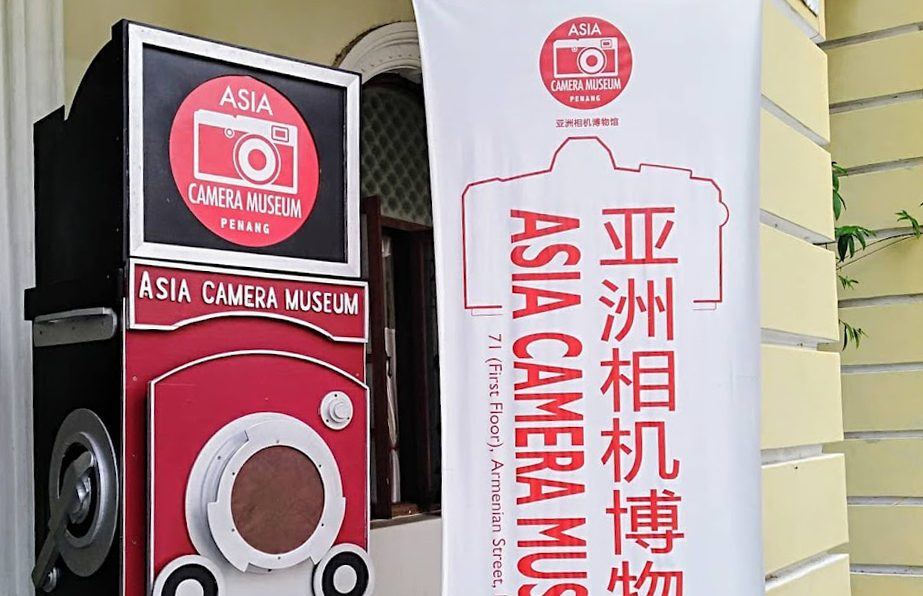
The Asia Camera Museum is a private museum of photography on the first floor of a shophouse at 71 Armenian Street, in the street art quarter of George Town. Open since January 2014, it holds more than 1,000 cameras and photographic accessories collected from Germany, Sweden, the United States, Japan and elsewhere, from wooden plate cameras to early digital models. Entry includes a guided tour that takes you through a camera obscura, a working-style darkroom and an old repair workshop, and you can pick up and try some of the vintage cameras yourself.
This guide covers the museum's background, what you will see, a short history of the cameras on show, tickets and opening hours (checked October 2026), how to get there and tips for visiting.
| Address | 71 Armenian Street, George Town |
|---|---|
| Details | Daily 10 am – 6 pm (arrive by 5:30 pm) RM25 including guided tour |
| Area | George Town |
| Typical visit | About 1 h |
| Listed in | Penang Attractions |
| Take me here | |
| Verified | Verified October 2026 |
About the Asia Camera Museum
The museum opened its doors to the public on 15 January 2014. Its stated aim is to show how photography developed through the equipment itself, so the collection was assembled for the historical importance of each item rather than its rarity alone. In its early years the museum was listed at a white heritage mansion on Jalan Burma, where it also ran a photo school teaching analogue and digital photography. It later moved to its present home on the first floor of 71 Lebuh Armenian, where the contents of a former portrait studio were also brought in.
The museum is a small, hands-on place rather than a formal gallery. It suits anyone who has used a film camera, families with older children who have only known phone cameras, and photographers interested in how their equipment evolved.
What to See at the Asia Camera Museum
The camera collection
Glass cases hold more than 1,000 cameras and accessories, arranged to show the development of photography from the early 20th century to recent models. You will see German, American, Japanese, French, British and Swedish makes, folding and box cameras, twin-lens reflexes, rangefinders, single-lens reflexes, spy and miniature cameras, toy cameras and early digital SLRs. Panels beside famous photographs note the camera that took them. Some vintage cameras are set out for visitors to pick up and look through.
The camera obscura
A walk-in camera obscura shows the principle behind every camera: light entering a small hole in a dark room projects an upside-down image of the scene outside onto the opposite wall. Artists used the effect as a drawing aid long before photography was invented, and seeing it inside a room makes the idea instantly clear.
The darkroom
The darkroom explains how photographs were made before digital sensors: exposing film, developing it in chemical baths, then projecting the negative onto light-sensitive paper with an enlarger to make prints. The guide walks you through each step and the equipment used.
The camera repair workshop
A recreated repair bench displays 1960s tools for servicing mechanical cameras, with cameras opened up to show shutters, gears and lens elements. It is a reminder of how much precision engineering went into film cameras before electronics took over.
Old portraits and the studio
Black-and-white portraits of Penang people from past decades line the walls, and a retro photo studio with old backdrops and props lets you take your own vintage-style pictures, using the museum's cameras or your phone.
A Short History of the Camera
The collection makes more sense with a little background. By the late 17th century portable camera obscura boxes and tents were in use as drawing aids. In 1826 Nicéphore Niépce made the first permanent photograph from a camera image, with an exposure of about eight hours, and Louis Daguerre's daguerreotype process, made public in 1839, cut exposures to minutes and soon to seconds. George Eastman's Kodak camera of 1888 came loaded with roll film for 100 exposures and put photography in ordinary hands. The Leica I of 1925 established 35 mm film for high-end compact cameras, the Rolleiflex twin-lens reflex of 1928 became hugely popular, and from the 1950s Japanese makers such as Nikon rose to dominate the market. Polaroid's Model 95 of the late 1940s was the first practical instant camera, Kodak engineer Steven Sasson built a digital camera prototype in 1975, and by 2003 digital cameras were outselling film. You can follow much of this story through the cases at the museum.
Asia Camera Museum Tickets and Opening Hours
The museum is open daily from 10 am to 6 pm. Entry is RM25, which includes a guided tour. Arrive by 5:30 pm, the last entry time, so there is enough time for the tour before closing. Most visitors spend 45 minutes to an hour, longer if you linger over the collection or the studio.
How to Get There
- On foot: the museum is upstairs at 71 Lebuh Armenian, in the middle of the street art area. The Sun Yat Sen Museum, Khoo Kongsi and the "Children on a Bicycle" mural are all within two or three minutes' walk, and the Clan Jetties about ten minutes.
- Bus: Rapid Penang routes from Komtar to Weld Quay stop along Lebuh Chulia and Pengkalan Weld, a short walk away; the free CAT shuttle also runs through the heritage zone.
- Grab or taxi: ask for "Asia Camera Museum, Lebuh Armenian". The street is narrow and busy, so drivers may drop you at either end.
- Parking: very limited street parking in the heritage zone.
Tips for Visiting
- The museum is reached by stairs to the first floor and is not accessible for wheelchair users.
- Visit in the early afternoon, when the street art lanes outside are hottest; the museum is a cool indoor break.
- Ask your guide questions: the tour is informal and staff are happy to explain how particular cameras work.
- Handle only the cameras set out for visitors, and ask before touching anything in the cases.
- Bring your own camera; the studio and the camera obscura make good subjects.
- Combine the visit with the Sun Yat Sen Museum and Khoo Kongsi for a half-day of Armenian Street sights, then eat at the hawker stalls and cafes along Lebuh Armenian and Lebuh Chulia.
Asia Camera Museum Location
Nearby
- Yap Kongsi and Choo Chay Keong Temple — Temple, 0.0 km away
- Armenian Street Souvenir Stalls — Souvenirs, 0.1 km away
- Areca Books — Souvenirs, 0.1 km away
- La Vie en Rose Patisserie — Dessert, 0.1 km away
- Khoo Kongsi — Attraction, 0.1 km away
- Sun Yat Sen Museum — Attraction, 0.1 km away
Plan a route with opening times using the Where2Go trip planner.
Frequently Asked Questions
How much is the Asia Camera Museum entrance fee?
Entry costs RM25 and includes a guided tour of the collection, the camera obscura, the darkroom and the repair workshop.
What are the Asia Camera Museum opening hours?
The museum is open daily from 10 am to 6 pm. Last entry is at 5:30 pm.
Where is the Asia Camera Museum?
It is on the first floor of 71 Armenian Street (Lebuh Armenian), George Town, near the Sun Yat Sen Museum and the Children on a Bicycle mural.
How long do I need at the Asia Camera Museum?
Allow 45 minutes to an hour, including the guided tour and time in the photo studio.
Can you touch the cameras at the Asia Camera Museum?
Yes, some vintage cameras are set out for visitors to pick up and try. Items inside the display cases should not be handled.
Is the Asia Camera Museum wheelchair accessible?
No. The museum is on the first floor and is reached only by stairs.