
Wat Chaiyamangalaram
Last updated: October 2026
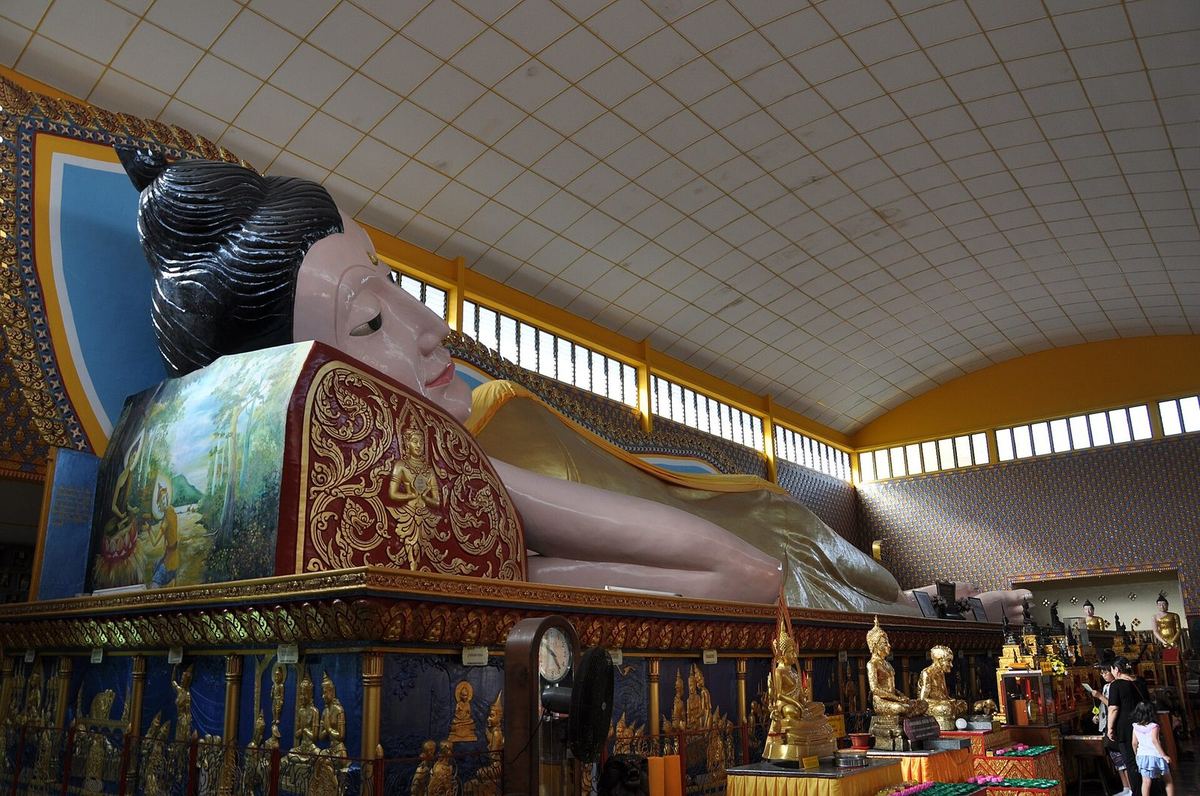
Wat Chaiyamangalaram (also spelt Wat Chayamangkalaram) is the largest Thai Buddhist temple in Penang and the home of one of the longest reclining Buddha images in Malaysia. The gold-robed figure, about 33 metres from end to end, fills the main hall of a temple on Lorong Burma in Pulau Tikus, directly across the lane from the Burmese temple Dhammikarama. The site dates from 1845, when the British authorities granted land here to Penang's Siamese community, and the temple is still the religious centre for Thai Buddhists on the island.
This guide covers its history, what to see, opening hours, etiquette, transport and nearby food, checked in October 2026.
| Address | 17 Lorong Burma, Pulau Tikus |
|---|---|
| Details | Daily, at least 8 am – 4 pm Free |
| Area | Pulau Tikus |
| Typical visit | About 30 min |
| Listed in | Penang Attractions |
| Take me here | |
| Verified | Verified October 2026 |
History of Wat Chaiyamangalaram
Siamese traders and settlers were part of Penang's population from the early years of the British settlement. In 1845 the Governor of the Straits Settlements, William John Butterworth, presented a land grant in Pulau Tikus to the Siamese community, represented by its women trustees; one widely repeated account dates the handover to 22 July 1845 and describes the plot as about five acres. The grant is usually described as a gift from Queen Victoria, and historians see it as a diplomatic gesture to support trade between the British and the Siamese kingdom in Bangkok. In the same year, neighbouring land was granted to the Burmese community for what is now the Dhammikarama Burmese Temple.
The temple's first monk was Phorthan Kuat (Phra Phorthan Kuad), remembered as the "Powerful Monk". Local tradition says he loved Penang asam laksa, and devotees still leave bowls of it as offerings at his shrine in the temple grounds. Inscriptions in the temple record that much of its building was paid for by Chinese Buddhist donors, a reminder of how closely the Thai and Chinese communities in Penang shared their religious life.
The temple was formally named Wat Chayamangkalaram in 1948. In 1958 the community built the reclining Buddha, Phra Chaiya Mongkol, for the 2,500th Buddha Jayanti anniversary, at a cost of M$100,000 (Malayan dollars). Some guidebooks date the statue to the 1960s, but the 1958 date is the one given by most published sources. In 1962 King Bhumibol Adulyadej and Queen Sirikit of Thailand visited the temple during their state visit to Malaya.
For decades the figure was described as the largest reclining Buddha in Malaysia and one of the longest in the world. It has since been overtaken in length by the 40-metre image at Wat Photivihan in Kelantan, but it remains the best-known reclining Buddha in the country.
What to See at Wat Chaiyamangalaram
The reclining Buddha
Phra Chaiya Mongkol lies on its right side with the head resting on the right hand, the traditional pose for the Buddha's passing into nirvana. It is about 33 metres (108 feet) long, covered in gold leaf, with a calm face and carefully painted feet and toenails. The statue doubles as a columbarium: niches in the wall behind and beneath it hold the urns of members of Penang's Thai community, each marked with a small photograph and name plate. Be respectful around them.
The main hall
Around the walls are rows of smaller Buddha images, along with Thai-style murals of the Buddha's life and lotus-patterned floor tiles. Small round stones in the grounds mark the boundary of the ordination area, where monks are ordained.
Guardians, nagas and the stupa
At the entrance stand a pair of tall guardian figures (yaksha), one with a green face and one with a red face, and the roof edges and stair rails are lined with naga, the many-headed serpents of Thai temple design. The grounds also hold a gilded stupa, a separate columbarium building, a crematorium and shrines including that of Phorthan Kuat. A small Thai community and cemetery have long been attached to the temple.
Festivals
The temple is the centre of Thai festivals in Penang: Songkran, the Thai New Year water festival in mid-April; Loy Krathong, the festival of floating offerings around the full moon of November; and Vesak Day, when devotees bring flowers, light candles and make merit.
Opening Hours, Entry and How Long to Spend
- Hours: daily, reliably from 8 am to 4 pm and often longer; some guides list the grounds as open from 7 am to 6 pm. The main hall can close earlier than the grounds.
- Entry: free; donations are welcome.
- Time needed: 20 to 30 minutes for this temple, or about an hour with Dhammikarama opposite.
- Phone: +60 4-226 8503.
How to Get to Wat Chaiyamangalaram
- Bus: Rapid Penang routes 101, 103 and 104 run from Weld Quay and Komtar along Jalan Burma (Burmah Road) or Jalan Kelawai. Get off at the Lorong Burma stop in Pulau Tikus and walk a few minutes up the lane.
- Grab or taxi: about 10 minutes from the George Town heritage core.
- Car: parking is along Lorong Burma and the surrounding lanes and fills up on festival days.
- On foot: roughly 15 minutes from Gurney Drive.
Tips for Visiting
- Cover shoulders and knees and take your shoes off before entering the main hall.
- Do not point your feet towards the Buddha, touch the statue or pose on the altars. Quiet photography without flash is generally accepted.
- The urns in the columbarium belong to local families, so avoid photographing them closely.
- Combine the visit with Dhammikarama Burmese Temple across the lane; a third place of worship, the Church of the Immaculate Conception, is a short walk away in Pulau Tikus.
- For food, Pulau Tikus Market and its coffee shops are a few minutes away, and Gurney Drive is a short ride for an evening hawker meal.
Wat Chaiyamangalaram Location
Nearby
- Dhammikarama Burmese Temple — Attraction, 0.1 km away
- Sun Kong Woh Dhoby & Dry Cleaning — Laundry, 0.2 km away
- Nusa Dua Massage Treatment House — Spa & massage, 0.4 km away
- Switch Service Centre, Gurney Paragon Mall — Phone repair, 0.5 km away
- Church of the Immaculate Conception — Temple, 0.5 km away
Plan a route with opening times using the Where2Go trip planner.
Frequently Asked Questions
How long is the reclining Buddha at Wat Chaiyamangalaram?
The reclining Buddha, Phra Chaiya Mongkol, is about 33 metres (108 feet) long. It was built in 1958 and also serves as a columbarium for urns of the local Thai community.
Is Wat Chaiyamangalaram free to enter?
Yes. Entry is free and donations are welcome.
What are the opening hours of Wat Chaiyamangalaram?
The temple is open daily and is reliably open from 8 am to 4 pm, often longer. Some guides list the grounds as open from 7 am to 6 pm.
When was Wat Chaiyamangalaram founded?
The temple was founded in 1845 on land granted to the Siamese community by the British colonial government, and its first monk was Phorthan Kuat.
What should I wear to Wat Chaiyamangalaram?
Wear clothing that covers your shoulders and knees, and remove your shoes before entering the main hall.