
Dhammikarama Burmese Temple
Last updated: October 2026
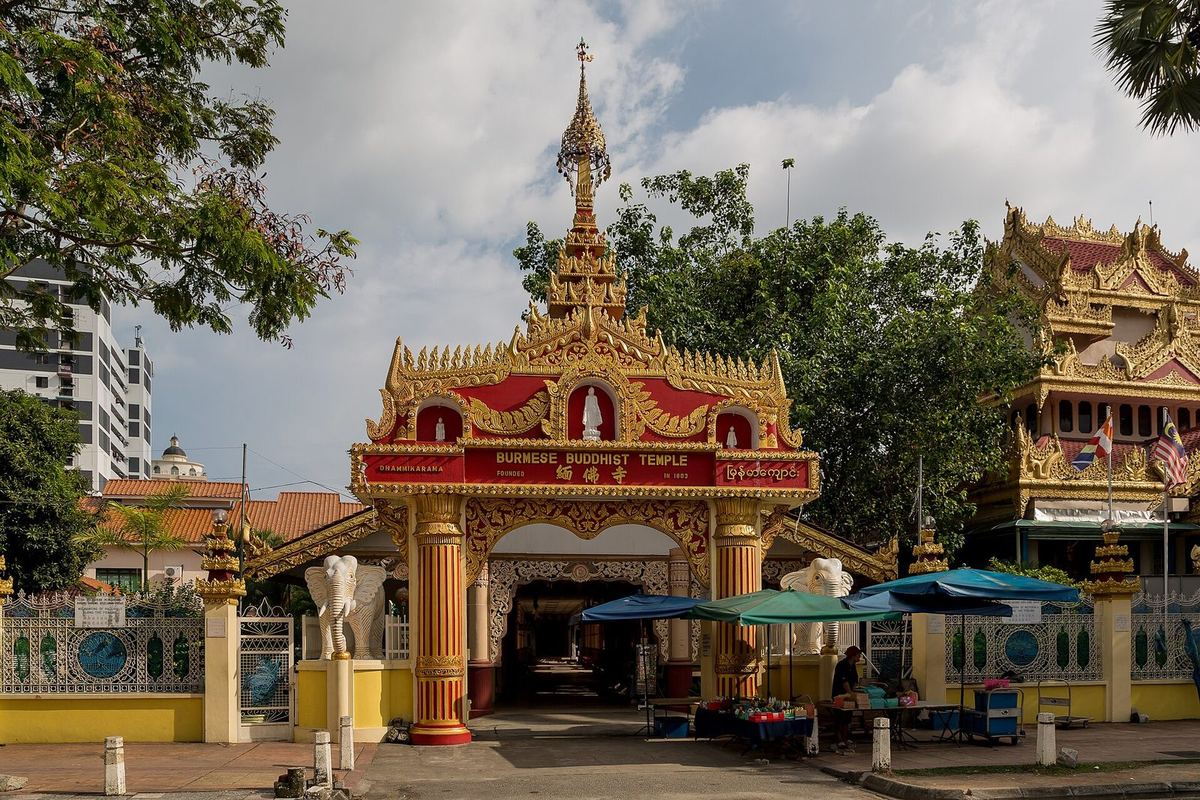
Dhammikarama Burmese Temple, on Lorong Burma (Burmah Lane) in Pulau Tikus, is the oldest Buddhist temple in Penang and the spiritual home of the island's Burmese community. It was founded on 1 August 1803, less than twenty years after the British East India Company set up its settlement at George Town, and is one of the few Burmese Theravada temples outside Myanmar. A pair of white stone elephants, gilded spires and a golden stupa make it easy to spot, and it faces the Thai temple Wat Chaiyamangalaram across the lane, so most visitors see both on the same trip.
This guide covers the temple's history, what to look for in the compound, opening hours, etiquette, how to get there and what else to do nearby, checked in October 2026.
| Address | 24 Lorong Burma, Pulau Tikus |
|---|---|
| Details | Daily about 6 am – 5:30 pm Free |
| Area | Pulau Tikus |
| Typical visit | About 30 min |
| Listed in | Penang Attractions |
| Take me here | |
| Verified | Verified October 2026 |
History of Dhammikarama Burmese Temple
The temple began as the Nandy Moloh Temple (also spelt Nandy Molah). The land was bought for 390 Spanish dollars from a man named George Layton by Nyonya Betong, a Burmese woman who donated it to the community. She and three other women, Nyonya Meerut, Nyonya Koloh and Nyonya Bulan, served as its first trustees, and the first abbot was a monk called U Nandamala. The temple was established on 1 August 1803, which makes it the earliest Buddhist temple in Penang.
The oldest structure still standing is the stupa, consecrated in 1805. In 1838 it was enclosed inside a larger outer stupa, the form you see today. In 1845, during the governorship of William John Butterworth, the East India Company granted further land on the same lane to two Burmese women trustees, Nongmay and Boonkhan, to expand the temple and provide a burial ground. In the same year a neighbouring plot was granted to the Siamese community, which became Wat Chaiyamangalaram, and that is why Penang's Burmese and Thai temples stand face to face on one short street.
The compound has grown steadily since. The shrine to Arahant Upagutta, a monk venerated in Burmese Buddhism as a protector, was first built of wood in 1840 and rebuilt in stone in 1976. The Sasana Vamsa Sima ordination hall, guarded by its stone elephants, was renovated in 1995. A memorial chedi honours U Jagara, the chief monk from 1922 to 1957. The most recent addition is the four-storey Golden Pagoda Bell Tower, which opened on 15 May 2011; it cost about RM3 million and was built with craftsmen brought in from Myanmar.
Dhammikarama is still a working monastery rather than a museum. Monks live on site, and the temple runs a Sunday school, a library and a lecture hall for Buddhist teaching.
What to See at the Temple
Entrance and guardians
The ordination hall is guarded by a pair of white stone elephants, and the entrance to the main prayer hall by a pair of chinthe, the lion-like guardian creatures of Burmese temples. Elsewhere in the grounds you will find garudas and the Panca Rupa, winged chimeras combining parts of several animals that symbolise the three realms of land, air and sea.
Main shrine hall
The main hall holds a large standing Buddha with a white marble face and hands, set against a gilded backdrop under a carved ceiling lacquered in brown. Look for the large mural of the Great Renunciation, which shows Prince Siddhartha leaving his palace on his horse Kanthaka to seek enlightenment.
Stupa, grottos and gardens
The gilded stupa, with the 1805 original sealed inside the 1838 outer shell, is the historic heart of the compound. Around the gardens are small grottos with Buddha images, many marked with the names of donors and with the animals of the zodiac, so visitors often look for the one matching their birth year. The original well, about two centuries old, is no longer used, and beside it is a carp pond.
Wishing pool and bell tower
The wishing pool has revolving metal bowls labelled with wishes such as health and wealth; visitors toss coins and try to land one in the bowl they want. The Golden Pagoda Bell Tower is the tallest structure in the compound and the best photo subject, especially in the late afternoon light.
Festivals
The temple is the focus of Thingyan, the Burmese water festival held around mid-April at the Burmese New Year, when devotees bathe Buddha images and splash water. It also marks Vesak, the Buddhist Lent (Vassa) during the rainy-season months, and the Mid-Autumn Festival. Festival days are crowded but show the temple at its liveliest as a community centre.
Opening Hours, Entry and How Long to Spend
- Hours: daily, about 6 am to 5:30 pm. Some sources give 8 am to 5 pm, so aim for the middle of the day if you want to be sure the halls are open.
- Entry: free. Donation boxes are placed around the compound.
- Time needed: about 30 minutes for this temple alone, or under an hour if you also cross the lane to Wat Chaiyamangalaram.
How to Get to Dhammikarama Burmese Temple
- Bus: Rapid Penang routes 101, 103 and 104 run along Jalan Burma (Burmah Road) or Jalan Kelawai from Weld Quay and Komtar. Get off near the Lorong Burma junction in Pulau Tikus and walk a few minutes up the lane.
- Grab or taxi: about 10 minutes from the George Town heritage core, depending on traffic.
- Car: street parking on Lorong Burma is limited and the lane is narrow; expect to circle the side streets on festival days.
- On foot: from Gurney Drive or Gurney Plaza it is roughly a 15-minute walk.
Tips for Visiting
- Dress modestly, with shoulders and knees covered, and take off your shoes before entering the shrine halls.
- Do not point your feet at Buddha images or climb on statues for photos. Ask before photographing monks.
- The open courtyards get hot by midday. Mornings are coolest, and late afternoon gives good light on the gilded spires.
- The compound is mostly flat, but some halls have steps at the entrance.
- For food, Pulau Tikus Market and the hawkers and coffee shops around it are a few minutes' walk away, and Gurney Drive's hawker centre is a short ride north.
- Combine the visit with Wat Chaiyamangalaram opposite and, if you have time, the Church of the Immaculate Conception in Pulau Tikus.
Dhammikarama Burmese Temple Location
Nearby
- Wat Chaiyamangalaram — Attraction, 0.1 km away
- Sun Kong Woh Dhoby & Dry Cleaning — Laundry, 0.2 km away
- Nusa Dua Massage Treatment House — Spa & massage, 0.5 km away
- Switch Service Centre, Gurney Paragon Mall — Phone repair, 0.6 km away
- Church of the Immaculate Conception — Temple, 0.6 km away
Plan a route with opening times using the Where2Go trip planner.
Frequently Asked Questions
Is there an entrance fee for Dhammikarama Burmese Temple?
No. Entry is free, and donations are welcome.
What are the opening hours of Dhammikarama Burmese Temple?
The temple is open daily from about 6 am to 5:30 pm. Some sources list 8 am to 5 pm, so visiting between those times is safest.
How old is Dhammikarama Burmese Temple?
It was founded on 1 August 1803 as the Nandy Moloh Temple, making it the oldest Buddhist temple in Penang. Its stupa was consecrated in 1805 and enclosed in a larger stupa in 1838.
Is there a dress code at Dhammikarama Burmese Temple?
Wear clothing that covers your shoulders and knees, and remove your shoes before entering the shrine halls.
Can I visit Dhammikarama and Wat Chaiyamangalaram together?
Yes. The two temples face each other across Lorong Burma in Pulau Tikus, and you can see both in under an hour.