
Thean Hou Temple, Kuala Lumpur
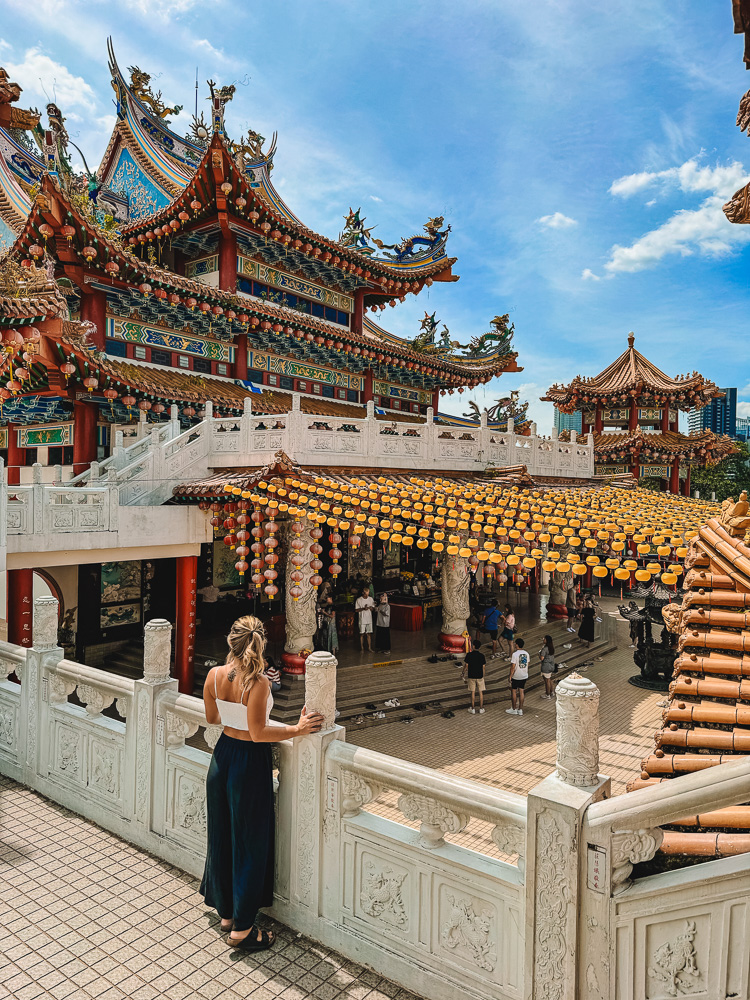
Thean Hou Temple is a six-tiered Chinese temple on Robson Heights, a hill just south of central Kuala Lumpur, dedicated to Tian Hou (Mazu), the goddess of the sea and protector of fishermen and travellers. It was built in the 1980s by the city's Hainanese community and is one of the largest Chinese temples in Kuala Lumpur, with sweeping tiled roofs, red pillars, carved balustrades and courtyards strung with hundreds of lanterns. Buddhist, Taoist and Confucian elements sit side by side, and the upper terraces look out over the city skyline. Entry is free.
This guide covers the temple's history, the halls and gardens, festivals, opening hours (checked October 2026), how to get there and etiquette for visitors.
| Address | 65 Persiaran Endah, Robson Heights |
|---|---|
| Hours | Daily 8 am – 10 pm (main prayer hall closes about 8 pm) |
| Take me here | |
| Verified | Verified October 2026 |
History of Thean Hou Temple
Hainanese migrants, many from fishing families on the island of Hainan in southern China, have long venerated Tian Hou, the deified sea goddess also known as Mazu, who is believed to protect people at sea. In Kuala Lumpur their community body, the Selangor and Federal Territory Hainan Association, decided to build a grand temple to her on a 1.67-acre plot on Robson Heights.
Mazu is the deified form of Lin Moniang, a woman from a fishing village on Meizhou Island in Fujian province who lived in the late 10th century. Traditional accounts say she was born in 960 and could protect people at sea; the best-known legend tells of her saving family members caught in a typhoon. Her cult spread with Chinese sailors and migrants along the coasts of Asia, and her birthday falls on the 23rd day of the third lunar month.
Construction began in 1981 and the temple was completed in 1987, at a cost of about RM7 million. It was officially opened on 3 September 1989. Beneath its traditional appearance the building is a modern reinforced-concrete structure; it is often described as a successful combination of modern building techniques and authentic traditional Chinese design. The Hainan Association still owns and runs the temple, and its offices are in the complex.
The temple is dedicated to three goddesses: Tian Hou in the centre, Guan Yin, the Buddhist Goddess of Mercy, on one side, and Shui Wei Sheng Niang, the Goddess of the Waterfront, a deity closely associated with the Hainanese, on the other. That mix of Buddhist and Taoist figures is typical of Chinese folk religion in Malaysia.
What to See at Thean Hou Temple
The main prayer hall
On the top tier, the grand prayer hall holds the three altars of Tian Hou, Guan Yin and Shui Wei Sheng Niang beneath a richly painted ceiling. Worshippers light joss sticks in the courtyard outside, and you can watch people consult fortune sticks. Visitors are welcome to enter quietly.
Roofs, terraces and lanterns
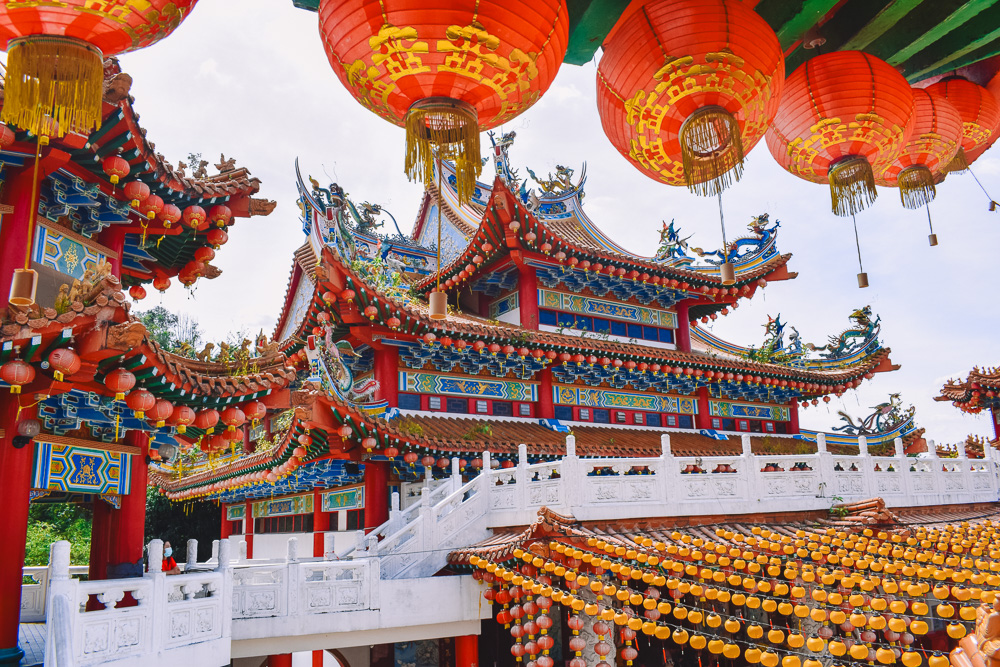
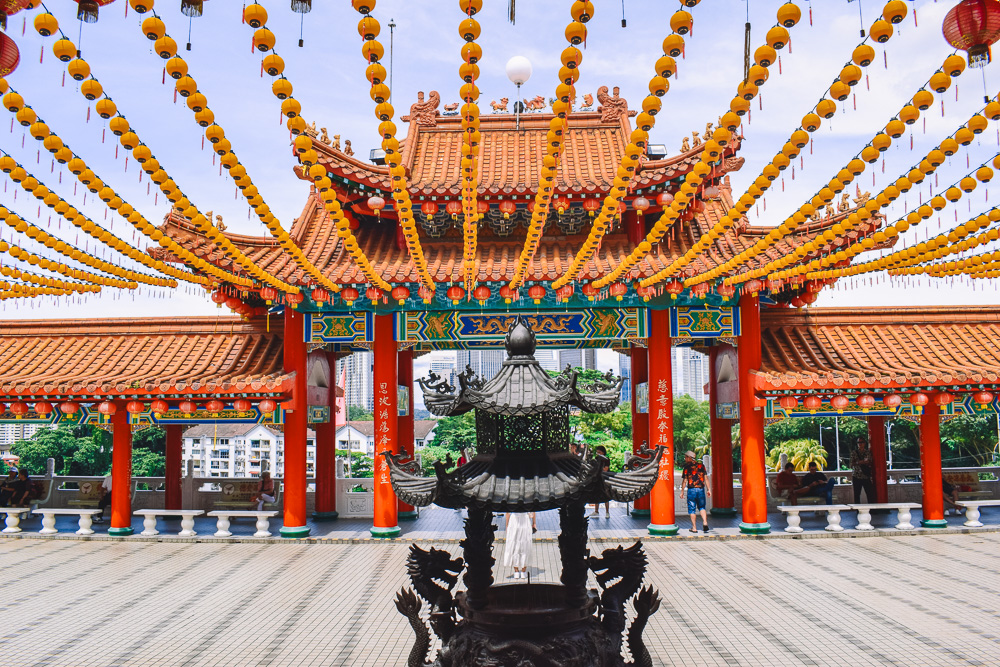
The layered roofs are topped with dragons and other ceramic figures, and the open terraces around the prayer hall give wide views of the Kuala Lumpur skyline. Rows of red (and at times yellow) lanterns hang over the central courtyard all year, and many more are added for festivals.
Zodiac garden, herb garden and tortoise pond
On the slope beside the temple, statues of the twelve animals of the Chinese zodiac stand with notes on the characteristics associated with each sign, a favourite stop for visitors looking for their own birth year. Nearby are a Chinese medicinal herb garden, a wishing well, a Guan Yin statue with a flowing water jar, and a pond full of tortoises.
Lower levels
The lower floors house the association's offices, a function hall used for weddings and events, souvenir stalls and a canteen. The temple is also a popular place to register marriages, and on auspicious dates you may see several wedding parties posing for photographs.
Festivals at Thean Hou Temple
- Chinese New Year: the most spectacular time to visit, with thousands of extra lanterns, lion dances and huge crowds; the temple attracts around 80,000 visitors over the season and keeps longer hours.
- Birthdays of the goddesses: major celebrations mark the birthdays of Tian Hou, Guan Yin and Shui Wei Sheng Niang through the lunar year, with offerings, prayers and performances.
- Mid-Autumn (Mooncake) Festival: lantern displays and evening crowds; Wesak Day is also observed.
The temple also hosts classes in tai chi, qigong and wushu, and fortune-telling services.
Thean Hou Temple Opening Hours and Admission
- Hours: daily 8 am to 10 pm; the main prayer hall closes earlier, at about 8 pm. Hours are extended during Chinese New Year and other festivals. Some older guides list shorter hours, so allow for the prayer hall closing in the evening.
- Admission: free; donations are welcome.
- Parking: on site; a small fee (a few ringgit) is sometimes charged.
- Time needed: 45 minutes to 1.5 hours.
- Contact: 03-2274 7088.
How to Get to Thean Hou Temple
- Grab or taxi: the simplest option, about 10 to 15 minutes from KL Sentral or Chinatown. Ask for "Thean Hou Temple, Persiaran Endah, Robson Heights".
- Rail plus walk: the closest stations, Tun Sambanthan monorail and Mid Valley KTM Komuter, are each about 1 km away, but the walk is partly uphill along busy roads with limited pavements. Most visitors take a short Grab from KL Sentral or Mid Valley instead.
- Car: turn off Jalan Syed Putra (the Federal Highway approach) towards Robson Heights; there is a car park at the temple.
Tips for Visiting Thean Hou Temple
- Come in the late afternoon for softer light and cooler air, then stay until dusk when the lanterns are lit and the city lights come on.
- Dress respectfully; covered shoulders are appreciated in the prayer hall. Shoes can be kept on in most areas, but follow any signs.
- Do not touch offerings or altar items, and ask before photographing worshippers. Photography of the halls and courtyards is generally fine.
- Avoid weekends around Chinese New Year if you dislike crowds, or go early in the morning.
- Combine the visit with Mid Valley Megamall, Brickfields (Little India) or the KL Sentral area, all a short ride away.
Thean Hou Temple Location
Photos
Frequently Asked Questions
Is Thean Hou Temple free to enter?
Yes. Entry is free and donations are welcome. Parking at the temple may carry a small fee.
What are Thean Hou Temple opening hours?
The grounds are open daily from 8 am to 10 pm, and the main prayer hall closes at about 8 pm. Hours are extended during Chinese New Year and other festivals.
Who is worshipped at Thean Hou Temple?
The temple is dedicated to Tian Hou (Mazu), the goddess of the sea, with altars to Guan Yin, the Goddess of Mercy, and Shui Wei Sheng Niang, the Goddess of the Waterfront.
When was Thean Hou Temple built?
The Selangor and Federal Territory Hainan Association built it between 1981 and 1987 at a cost of about RM7 million, and it was officially opened on 3 September 1989.
How do I get to Thean Hou Temple?
Grab or taxi is easiest, about 10 to 15 minutes from KL Sentral. Tun Sambanthan monorail and Mid Valley KTM stations are about 1 km away, but the walk is uphill along busy roads.
When is the best time to visit Thean Hou Temple?
Late afternoon into dusk for the views and lanterns, or the Chinese New Year season for the full lantern display, though it is very crowded then.